

Swati Tyagi
Senior Full Stack and Mobile App Developer
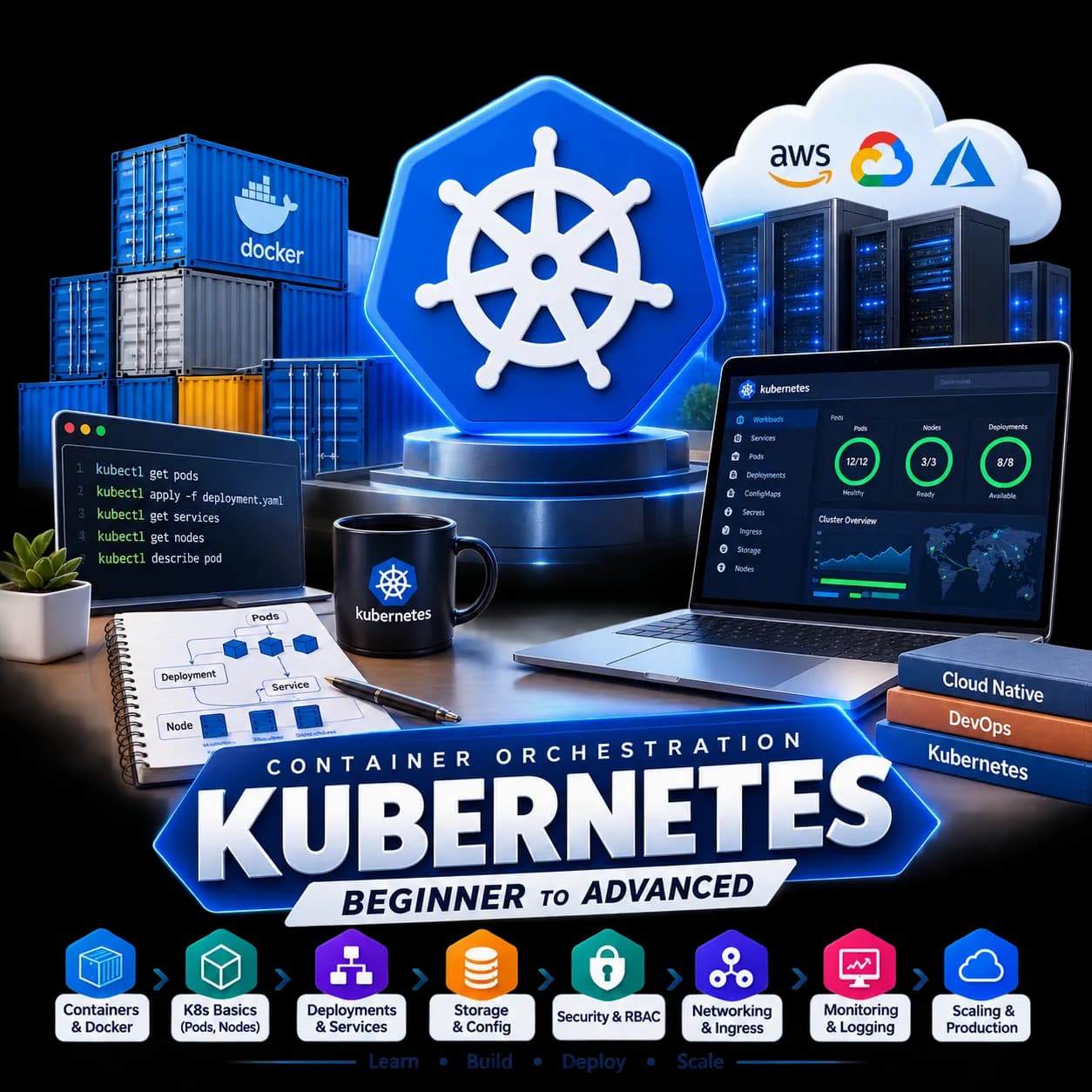
Master Kubernetes from zero to production — Pods, Deployments, Services, Helm, RBAC, autoscaling, GitOps with ArgoCD, and multi-cluster management.

Run applications the way modern engineering teams do. Kubernetes: Beginner to Advanced takes you from container fundamentals to managing resilient production clusters that self-heal under load. Every major tech stack relies on container orchestration today, and knowing how to build, secure, and debug clusters is the dividing line between an operator who runs commands and an engineer who designs reliable systems.
You will start by breaking down the control plane — understanding how the API server, etcd, and kube-scheduler coordinate state across worker nodes. From there, you write real declarative YAML manifests, launch multi-container pods, and configure rolling updates that never drop client traffic.
Theory alone does not survive a midnight production outage. Throughout this course, you build concrete, end-to-end deliverables that mirror real-world cloud infrastructure:
This training is built for backend developers, systems administrators, site reliability engineers, and aspiring cloud practitioners who want to move beyond basic container execution. If you are preparing for the Certified Kubernetes Administrator (CKA) or Certified Kubernetes Application Developer (CKAD) exams, this curriculum covers every domain required to pass on your first attempt.
Basic familiarity with Linux commands and container concepts will help you move fast. If you are starting completely fresh with containers, pair your studies with the Docker — From Zero to Production course first. When you finish those fundamentals, Kubernetes becomes the logical next step in your professional toolkit.
Classes run as live interactive cohorts where working engineers teach production patterns rather than textbook theory. You write configuration live, break clusters on purpose, and learn how to debug common failure modes like CrashLoopBackOff, ImagePullBackOff, and NodeNotReady errors. Every lab runs on your local machine or in cloud sandboxes with zero complex infrastructure setup required.
You will also benefit from weekly code reviews on your own GitHub repositories, ensuring your YAML manifests follow industry best practices for security and resource efficiency.
Modern engineering teams operating distributed architectures list Kubernetes on almost every senior backend and DevOps role. Companies moving away from monolithic setups require engineers who can provision PersistentVolumes, manage ingress traffic routing with NGINX, and set up robust monitoring alongside tools covered in the System Monitoring & Observability curriculum.
Technical interview loops for these roles test your ability to troubleshoot failing pods, inspect cluster logs, configure network policies, and explain how requests flow from an external load balancer down to container namespaces. This course prepares you directly for those evaluation rounds.
Mastering container orchestration opens doors to advanced cloud architectures across AWS, GCP, and Azure. For a broader path through pipelines and infrastructure automation, explore the DevOps & Automation Bootcamp or deepen your cloud expertise with Google Cloud (GCP). Join our next cohort and take complete control of your production infrastructure.
A structured curriculum with real tools and outcomes built for the workplace.
You can explain cluster internals, configure local environments with minikube and kind, and run imperative vs declarative kubectl commands.
Hands-on project: Spin up a local multi-node kind cluster, inspect control plane component logs, and deploy a test NGINX pod declaratively using a YAML manifest with resource limits.
You can configure pod lifecycles, manage multi-container design patterns, and execute zero-downtime rolling deployments.
Hands-on project: Deploy an API service with sidecar logging, configure readiness and liveness probes, and perform a rolling update followed by a clean rollback.
You can expose cluster workloads through ClusterIP, NodePort, LoadBalancer services, and secure HTTP routing with Ingress controllers.
Hands-on project: Deploy an NGINX Ingress controller, create path-based routing rules for frontend and backend services, and isolate pod traffic using NetworkPolicies.
You can decouple application settings and sensitive credentials from code using ConfigMaps, Secrets, and external secret operators.
Hands-on project: Inject application database credentials via Kubernetes Secrets and configuration properties via ConfigMaps mounted both as environment variables and files.
You can provision persistent storage dynamically using StorageClasses, PersistentVolumeClaims, and CSI drivers.
Hands-on project: Provision dynamic storage for a database deployment using local StorageClasses and verify data persistence across pod restarts and rescheduling.
You can orchestrate stateful databases, node-level log collectors, and batch processing jobs.
Hands-on project: Deploy a replicated MySQL cluster using StatefulSets backed by a headless service and schedule daily database backups using CronJobs.
You can enforce cluster security using RBAC roles, ServiceAccounts, Pod Security Standards, and admission controllers.
Hands-on project: Create a restricted developer ServiceAccount with read-only namespace access via Role and RoleBinding, and audit container vulnerabilities using Trivy.
You can package, version, and distribute applications using custom Helm charts and manage multi-chart deployments with Helmfile.
Hands-on project: Build a reusable Helm chart for a microservice application from scratch, parameterize environment variables via values.yaml, and deploy via Helmfile.
You can configure Horizontal Pod Autoscalers, Cluster Autoscalers, and resource quotas to optimize cloud spend and performance.
Hands-on project: Set up an HPA driven by custom CPU metrics, define Namespace resource quotas, and configure KEDA for queue-based event scaling.
You can implement end-to-end cluster observability with Prometheus, Grafana, central logging, and distributed tracing.
Hands-on project: Deploy the Prometheus Operator stack, build a custom Grafana dashboard for pod memory and CPU metrics, and configure Alertmanager notifications.
You can build automated deployment pipelines and implement pull-based GitOps workflows using ArgoCD and GitHub Actions.
Hands-on project: Set up ArgoCD to synchronize cluster manifests automatically from a Git repository and configure GitHub Actions to build and push container images.
You can upgrade a live cluster and restore it after losing the control plane.
Hands-on project: Back up etcd and namespace state with Velero, perform a control-plane and node-pool upgrade respecting version skew with workloads staying available, then restore one namespace into a fresh cluster and verify the application runs.
You can administer multi-node production clusters, perform etcd backups, manage upgrades, and deploy an end-to-end cloud-native capstone system.
Hands-on project: Deploy a complete multi-tier microservices application onto a production-grade Kubernetes cluster using Helm charts, manage secrets via External Secrets, monitor via Prometheus/Grafana, automate delivery via ArgoCD, and execute an etcd disaster recovery drill.
Every instructor here ships production code for a living and teaches the same week they deploy.
5 learners sharing their experience

The Full-Stack Java developer program at Squarebrackets completely transformed my career. Learning Spring Boot and microservices architecture alongside React and Next.js gave me the exact modern stack companies are looking for. Building real-time projects using Apache Kafka and RabbitMQ for message queuing gave me the practical confidence I needed to ace my system design rounds.
Ankit transitioned from a legacy support engineer to a high-paying product development role after completing his 6-month intensive Java and JavaScript full-stack training at our Noida campus.

Squarebrackets took me from not knowing what a gradient was to building and deploying CNNs and Transformers. The maths-first approach made everything click, and the mentors pushed me through every hard concept.
Completed the Deep Learning Course at Squarebrackets and landed a deep learning role within two months.

Squarebrackets gave me the complete AI picture — from search algorithms and Bayesian reasoning to building LLM agents. The maths-first approach meant nothing was a black box, and the mentors pushed me through every project.
Completed the Artificial Intelligence Course at Squarebrackets and moved into an AI engineering role within two months.

The Java Full-Stack and DSA course at Squarebrackets completely changed my career trajectory. The focus on raw problem-solving with DSA alongside hands-on Spring Boot and React projects gave me the practical skills I needed. I went from struggling with basic coding rounds to cracking my technical interview with absolute confidence.
Aniket joined Squarebrackets as a college senior looking to transition from theoretical academic projects to production-ready software development. After completing our rigorous training program, he secured a placement as an Associate Software Engineer.
The live cohort broke down complex concepts like Spring Boot transaction management and React state handling in a way that made immediate sense for production work. Having worked through real backend architectures during class, my daily code reviews at work became much smoother.
Completed the Java Full Stack live training while balancing a full-time role, upgrading engineering skills through rigorous hands-on sessions.

“The Full-Stack Java developer program at Squarebrackets completely transformed my career. Learning Spring Boot and microservices architecture alongside React and Next.js gave me the exact modern stack companies are looking for. Building real-time projects using Apache Kafka and RabbitMQ for message queuing gave me the practical confidence I needed to ace my system design rounds.”

Software Engineer, Student
“Squarebrackets took me from not knowing what a gradient was to building and deploying CNNs and Transformers. The maths-first approach made everything click, and the mentors pushed me through every hard concept.”

Student
“Squarebrackets gave me the complete AI picture — from search algorithms and Bayesian reasoning to building LLM agents. The maths-first approach meant nothing was a black box, and the mentors pushed me through every project.”

Student
“The Java Full-Stack and DSA course at Squarebrackets completely changed my career trajectory. The focus on raw problem-solving with DSA alongside hands-on Spring Boot and React projects gave me the practical skills I needed. I went from struggling with basic coding rounds to cracking my technical interview with absolute confidence.”
Associate Software Engineer, Capgemini
“The live cohort broke down complex concepts like Spring Boot transaction management and React state handling in a way that made immediate sense for production work. Having worked through real backend architectures during class, my daily code reviews at work became much smoother.”

Student


Browse the common questions, or reach out and our team will help you directly.
10 courses in this collection
Microsoft Azure Solutions Architect & DevOps Expert (AZ-900, AZ-305, AZ-400) Beginner24 Weeks

Advanced DevOps and Infrastructure Engineering Course Beginner22 Weeks
Docker — From Zero to Production Intermediate12 Weeks (93 Hours)

Google Cloud (GCP) Advanced5 Months (20 Weeks)
Azure Cloud Advanced5 Months (20 Weeks)
Linux Intermediate3 Months (12 Weeks)

System Monitoring & Observability Advanced4 Months (16 Weeks)
Git & GitHub Advanced12 Weeks (90 Hours)

Jenkins Intermediate3 Months (12 Weeks)

AWS Cloud Advanced5 Months (20 Weeks)
Best seller
Best seller
Best seller
New
New
New
New
New
Trending
NewHands-on programming tracks with runnable code, from fundamentals to job-ready projects.
Kubernetes Beginner to Production Grade: A Hands-On DevOps Guide Beginner25 min

100 Days of DSA with Java Beginner to advanced100 days · 85 lessons published

100 Days of AI Engineering Beginner to advanced100 days · 57 lessons published


Articles to help you learn, grow, and get hired.
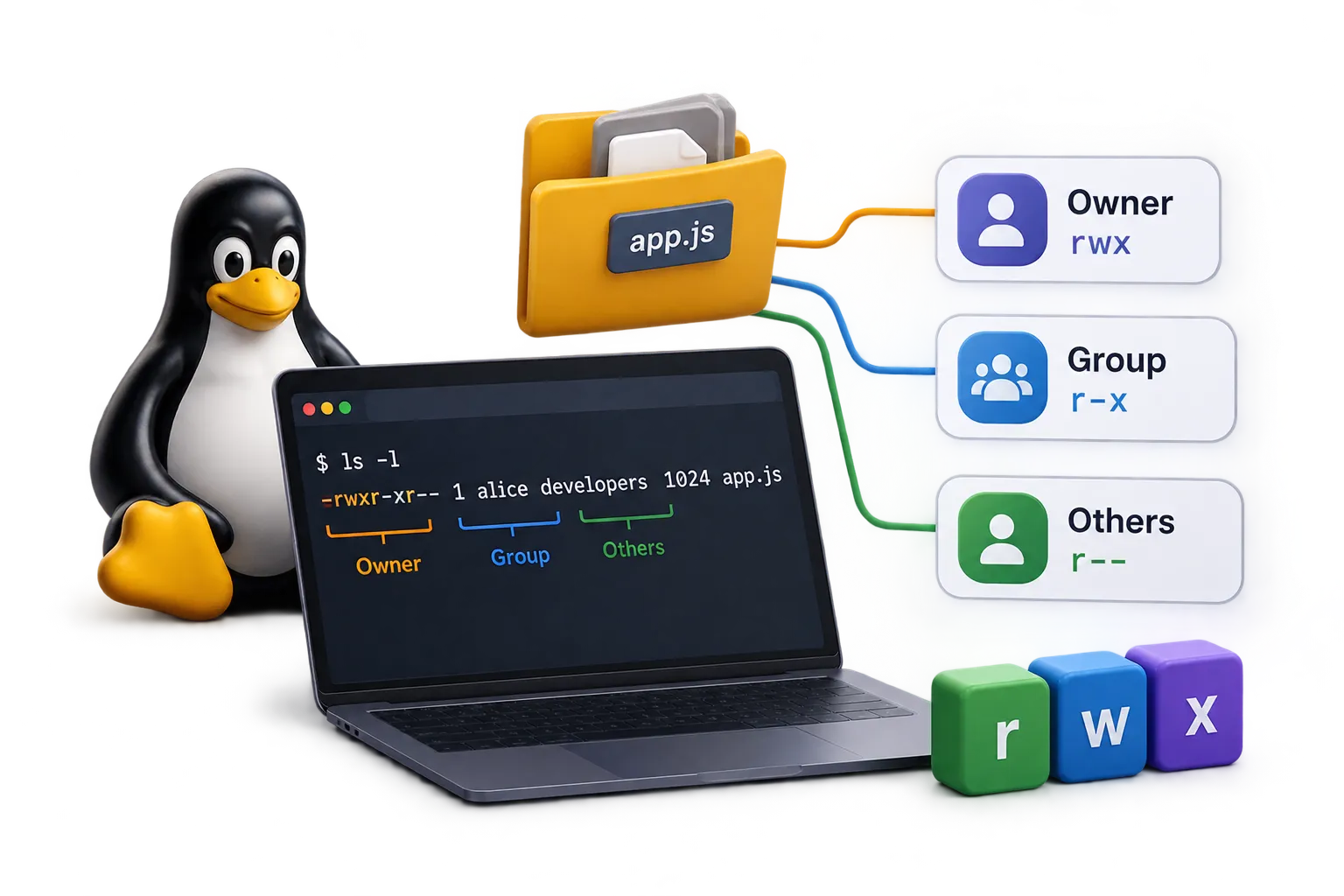
Linux Groups and File Permission: Complete Admin Guide 5 min11 Sept 2026

Terraform Architecture Explained: How It Works Under the Hood 5 min9 Sept 2026
Git vs GitLab: What's the Difference? (Simple Guide for Beginners) 5 min23 Jun 2026
Master Linux groups and File Permission with this practical guide covering user creation, group memberships, sudo privileges, and file permissions.

Demystify Terraform architecture. Learn how the Core, State files, Providers, and APIs interact to manage Infrastructure as Code safely.
TrendingA beginner-friendly guide to the real difference between Git and GitLab, explained in plain English with a simple real-life example anyone can understand.