

Ravi Tyagi
Lead AI Engineer & Generative AI Systems Engineer
Master Generative AI and Agentic AI from scratch to production. Build, optimize, and deploy multi-agent systems, advanced RAG pipelines, and LLM applications using LangChain, CrewAI, LlamaIndex, and vLLM.

Building a Production-Grade Generative AI and Agentic AI Engineer pipeline requires far more than basic API calls and simple prompt templates. This intensive program takes you from understanding transformer mathematics all the way to deploying resilient, self-correcting multi-agent networks in production environments. You will learn how to design, test, and scale cognitive systems that solve genuine business problems without breaking under concurrency.
You learn by shipping real code against strict production constraints. Rather than toy scripts, your portfolio will include:
This curriculum is built for backend developers, software engineers, and technical leads who want to master modern AI engineering. If you already write clean Python and understand how web APIs work, you will find the architectural depth you need here. Before joining, many learners build foundational confidence through our 100 Days of AI Engineering free tutorial or explore core concepts in our Agentic AI vs Generative AI: How to Start Learning in 2026 guide. It is not an introductory course for absolute beginners, nor is it a high-level overview for product managers. You will write code in every single session, debug failing async loops, and configure real infrastructure.
Cohorts meet via live, interactive online sessions led by working engineers who build distributed AI systems daily. We skip monotonous slide decks. Instead, we do live architectural design reviews, walkthroughs of failing test suites, and pair-debugging of agent deadlocks. You can ask questions in real time, review complete code repositories on GitHub, and get detailed code reviews on your capstone implementations.
Engineering teams across global product companies and scale-ups are actively replacing fragile prompt wrappers with autonomous agentic architectures. Roles such as AI Engineer, Generative AI Architect, and systems builder require deep familiarity with orchestration frameworks, vector database internals, and LLMOps monitoring. Interviewers no longer test whether you know how to call an LLM endpoint. They probe your ability to handle hallucinations, optimize inference costs, secure endpoints against prompt injection, and debug multi-agent loops. Completing this program gives you the exact production patterns tested in senior engineering hiring loops.
Ready to build the future of software? Review our prerequisite checklist and explore related comprehensive tracks such as our Advanced AI-Driven Full-Stack Cloud Architect Program for scaling distributed cloud systems.
A structured curriculum with real tools and outcomes built for the workplace.
You can explain what a language model is doing when it answers, in terms a sceptical engineer will accept, and say what it cannot do.
Hands-on project: Write a technical explainer for your team covering tokenisation, sampling and why the same prompt gives different answers, with three worked examples.
You can read a transformer diagram and say what each block does, which is what makes the rest of the course something you reason about rather than copy.
Hands-on project: Implement a minimal decoder-only transformer from scratch in PyTorch and train it on a small corpus until it produces coherent text.
You can get reliable, structured output from a model and know which failures are prompt problems and which are not.
Hands-on project: Build a classification service that returns schema-valid JSON for a thousand varied inputs with a measured failure rate under one percent.
You can choose an embedding model and index type for a corpus and justify both on recall and cost rather than popularity.
Hands-on project: Benchmark three embedding models and two index types over a real corpus and publish a recommendation with measured recall and latency.
You can build a retrieval-augmented system that grounds answers in your documents and cites them, and explain every stage of the pipeline.
Hands-on project: Build a RAG service over a real document corpus with citation rendering, a measured accuracy baseline and a documented failure analysis.
You can take a mediocre RAG system and make it measurably better, knowing which lever to pull for which failure mode.
Hands-on project: Improve a baseline RAG system's answer accuracy by at least twenty points through hybrid retrieval, reranking and query transformation, with each gain attributed.
You can prove a change helped with numbers an engineering manager will accept, instead of vibes from a handful of prompts.
Hands-on project: Build an evaluation suite with a hundred cases covering faithfulness, relevance and retrieval recall, running in CI.
You can give a model tools and have it select them correctly, which is the single step that turns a chatbot into a system that does work.
Hands-on project: Build a six-tool assistant with typed schemas and a test proving each tool is chosen for the right intent and rejected for the wrong one.
You can build a multi-agent workflow with explicit state and durable checkpoints, and say honestly when one agent would have been better.
Hands-on project: Build a research-and-report pipeline with four specialised agents, persistent checkpoints, human approval gates and a measured comparison against a single-agent baseline.
You can decide between prompting, RAG and fine-tuning on evidence, and run a fine-tune that actually improves a measured metric.
Hands-on project: Fine-tune a small open model for a narrow task, measure it against a prompted baseline, and write up whether it was worth doing.
You can adapt an open model on a single GPU and explain the memory arithmetic that makes it possible.
Hands-on project: Train a LoRA adapter on a domain dataset within a 24 GB memory budget, merge it, and serve the result.
You can serve an open model at a throughput and latency you can defend, and explain where every millisecond and gigabyte goes.
Hands-on project: Deploy a model with vLLM, load-test it, and publish a capacity model giving tokens per second per GPU at a target p95 latency.
You can run a generative system as a service with versioning, tracing and a cost line someone in finance will accept.
Hands-on project: Deploy a RAG service with full tracing, a cost dashboard, canary rollout and an automated rollback trigger.
You can pass a security and compliance review for a generative system, with evidence rather than assurances.
Hands-on project: Produce a governance package: threat model, prompt-injection test results, PII handling design, audit logging and a model usage policy.
You can deliver a complete generative AI system to production standard: grounded, evaluated, observable, secured and costed.
Hands-on project: Build and deploy a production platform over a real corpus: ingestion and indexing pipeline, hybrid retrieval with reranking, an agentic query layer with tools, a fine-tuned or adapted component where justified, vLLM serving, full tracing and cost dashboard, a hundred-case evaluation suite in CI, prompt-injection test results and a governance pack, defended in review.
Every instructor here ships production code for a living and teaches the same week they deploy.
5 learners sharing their experience
The Full-Stack Java developer program at Squarebrackets completely transformed my career. Learning Spring Boot and microservices architecture alongside React and Next.js gave me the exact modern stack companies are looking for. Building real-time projects using Apache Kafka and RabbitMQ for message queuing gave me the practical confidence I needed to ace my system design rounds.
Ankit transitioned from a legacy support engineer to a high-paying product development role after completing his 6-month intensive Java and JavaScript full-stack training at our Noida campus.

Squarebrackets took me from not knowing what a gradient was to building and deploying CNNs and Transformers. The maths-first approach made everything click, and the mentors pushed me through every hard concept.
Completed the Deep Learning Course at Squarebrackets and landed a deep learning role within two months.

Squarebrackets gave me the complete AI picture — from search algorithms and Bayesian reasoning to building LLM agents. The maths-first approach meant nothing was a black box, and the mentors pushed me through every project.
Completed the Artificial Intelligence Course at Squarebrackets and moved into an AI engineering role within two months.

The Java Full-Stack and DSA course at Squarebrackets completely changed my career trajectory. The focus on raw problem-solving with DSA alongside hands-on Spring Boot and React projects gave me the practical skills I needed. I went from struggling with basic coding rounds to cracking my technical interview with absolute confidence.
Aniket joined Squarebrackets as a college senior looking to transition from theoretical academic projects to production-ready software development. After completing our rigorous training program, he secured a placement as an Associate Software Engineer.
The live cohort broke down complex concepts like Spring Boot transaction management and React state handling in a way that made immediate sense for production work. Having worked through real backend architectures during class, my daily code reviews at work became much smoother.
Completed the Java Full Stack live training while balancing a full-time role, upgrading engineering skills through rigorous hands-on sessions.

“The Full-Stack Java developer program at Squarebrackets completely transformed my career. Learning Spring Boot and microservices architecture alongside React and Next.js gave me the exact modern stack companies are looking for. Building real-time projects using Apache Kafka and RabbitMQ for message queuing gave me the practical confidence I needed to ace my system design rounds.”

Software Engineer, Student
“Squarebrackets took me from not knowing what a gradient was to building and deploying CNNs and Transformers. The maths-first approach made everything click, and the mentors pushed me through every hard concept.”

Student
“Squarebrackets gave me the complete AI picture — from search algorithms and Bayesian reasoning to building LLM agents. The maths-first approach meant nothing was a black box, and the mentors pushed me through every project.”

Student
“The Java Full-Stack and DSA course at Squarebrackets completely changed my career trajectory. The focus on raw problem-solving with DSA alongside hands-on Spring Boot and React projects gave me the practical skills I needed. I went from struggling with basic coding rounds to cracking my technical interview with absolute confidence.”
Associate Software Engineer, Capgemini
“The live cohort broke down complex concepts like Spring Boot transaction management and React state handling in a way that made immediate sense for production work. Having worked through real backend architectures during class, my daily code reviews at work became much smoother.”

Student







Browse the common questions, or reach out and our team will help you directly.
Hands-on programming tracks with runnable code, from fundamentals to job-ready projects.
 Docker Tutorial — Learn Docker from Scratch | Squarebrackets Intermediate15 Hours
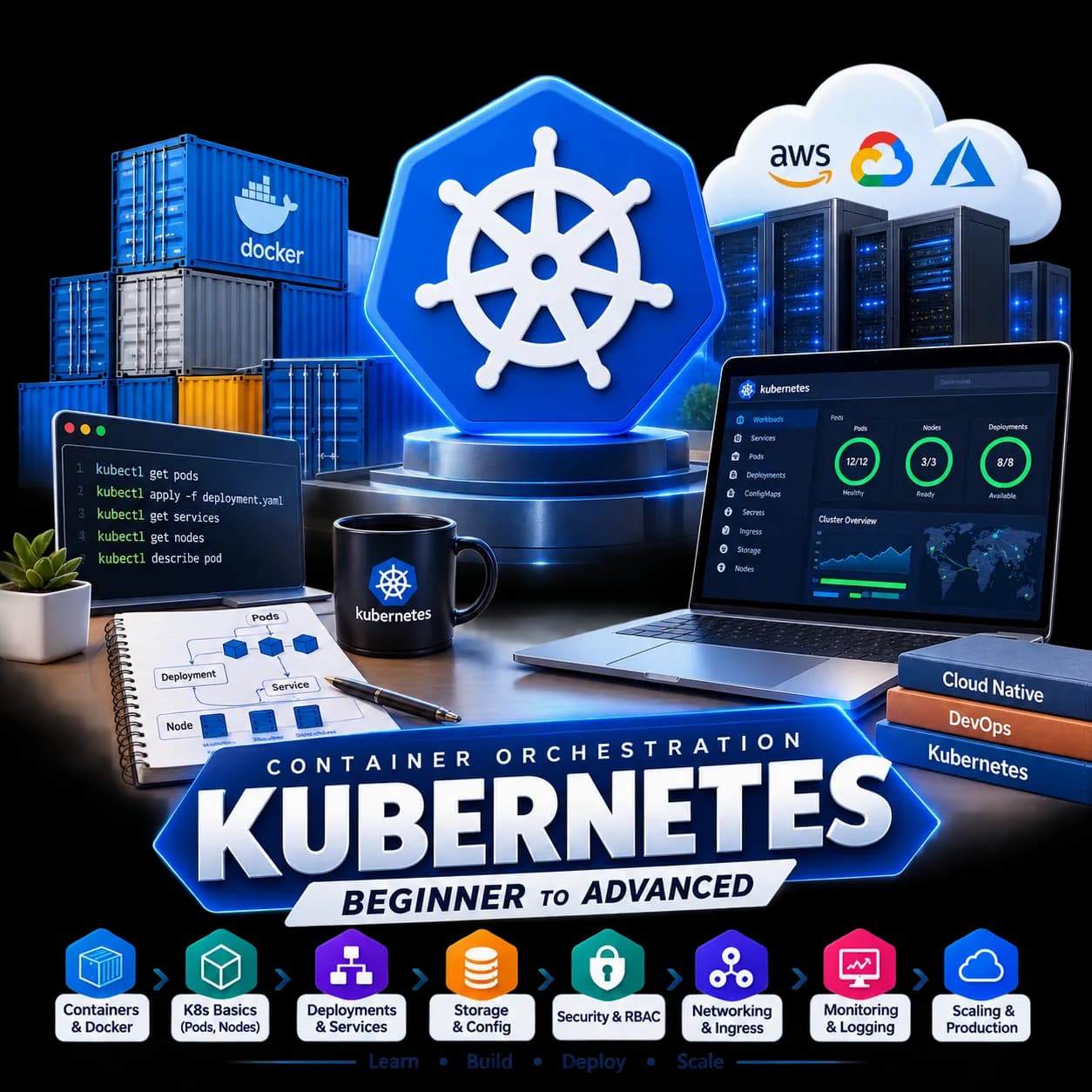 Kubernetes Beginner to Production Grade: A Hands-On DevOps Guide Beginner25 min
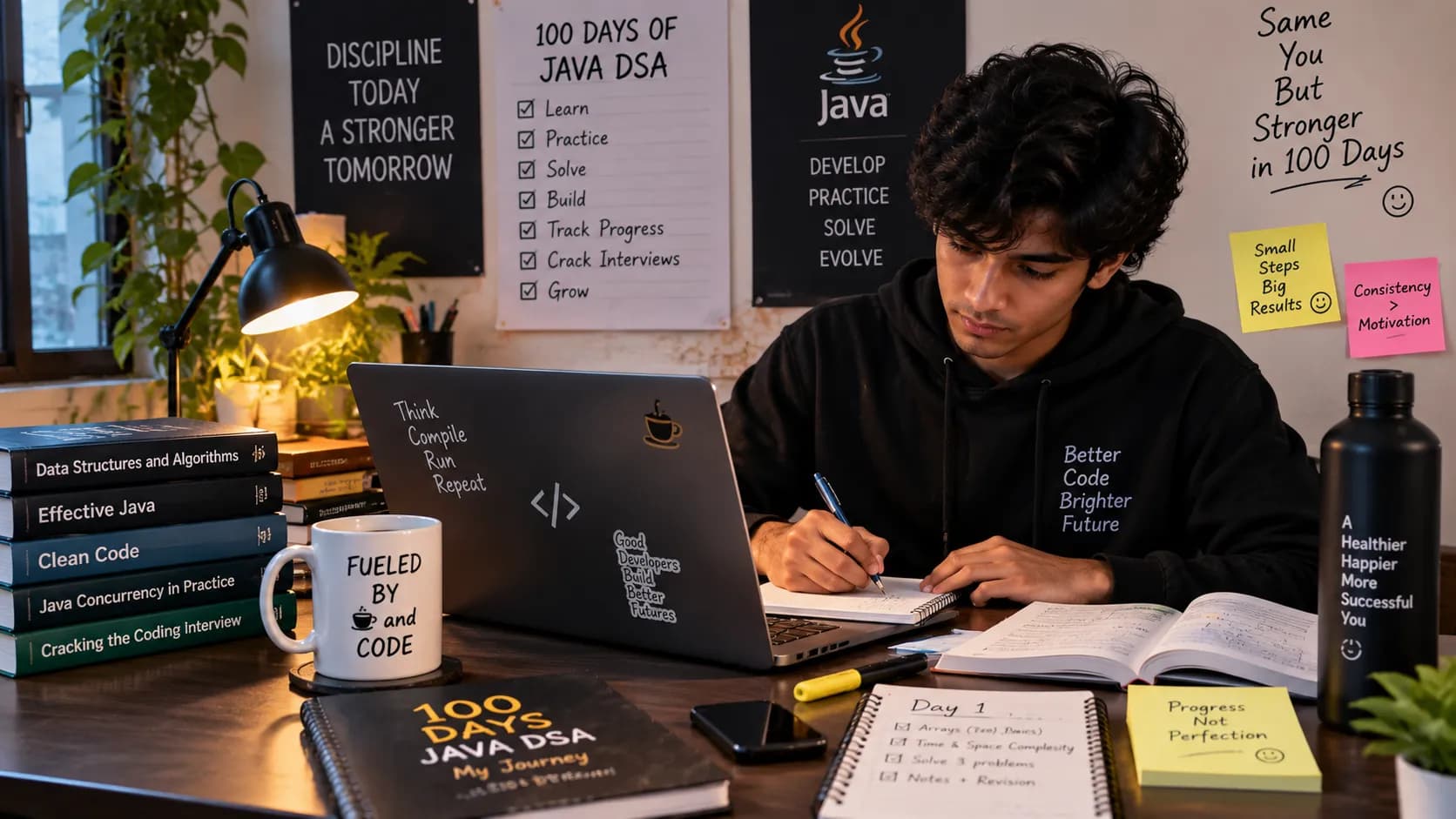 100 Days of DSA with Java Beginner to advanced100 days · 85 lessons published
 100 Days of AI Engineering Beginner to advanced100 days · 57 lessons published