

AI/Automation
JSON vs TOON: The Problem and the Fix for LLM Data Transfer
Discover why JSON costs you money in LLM APIs and how TOON (Token Object-Oriented Notation) fixes token bloat for efficient AI automation.

 Hover to zoom
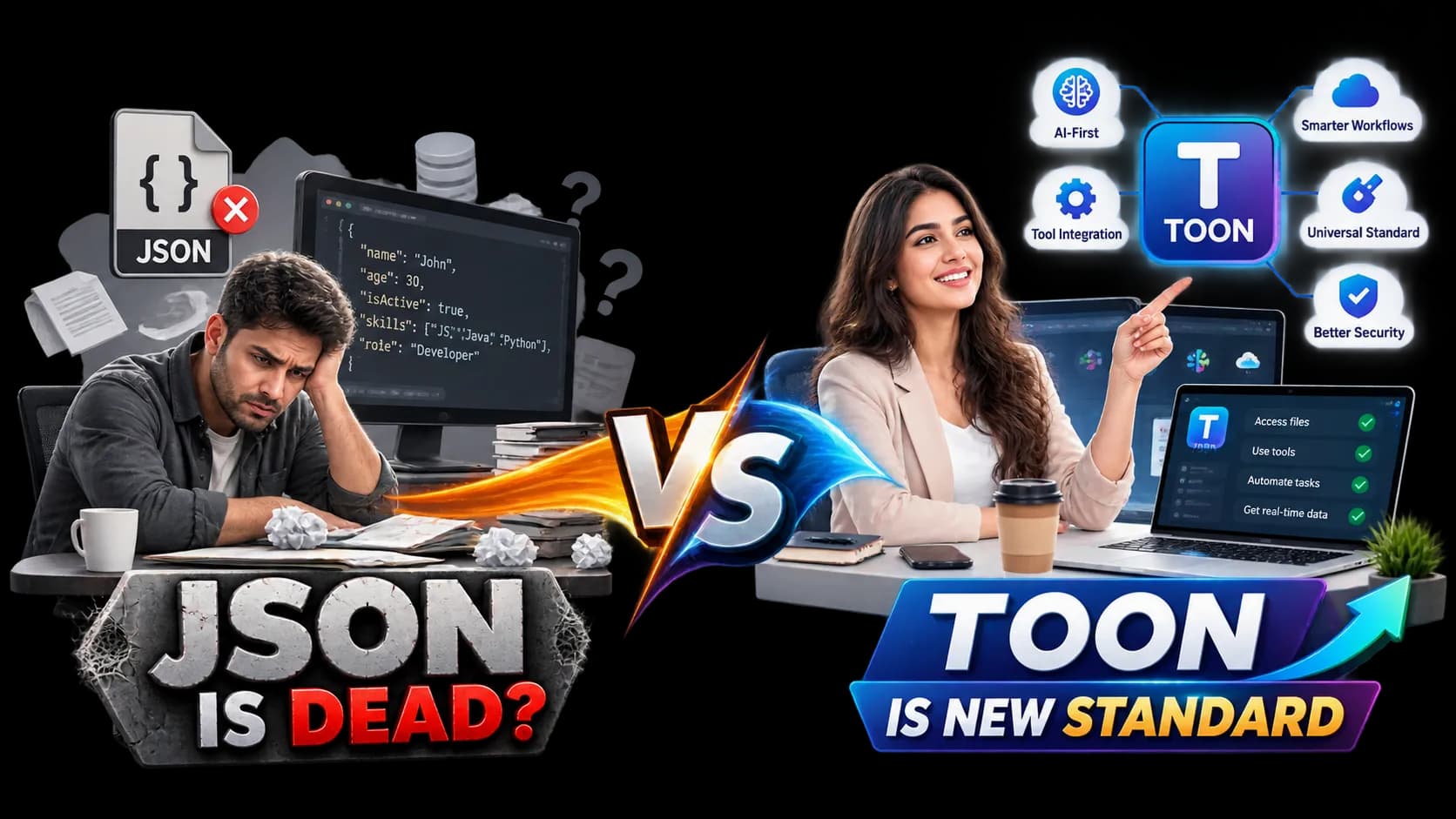
JSON is nearly thirty years old, and for most of that time, it has never lost an argument. It won the web browser, it won the REST API, and it replaced XML for configuration files. But then we entered the era of AI and automation. We started pushing massive datasets into Large Language Models (LLMs), and suddenly, JSON's design started costing us real money. This is where the debate of json vs toon begins, exposing how a format built for machines hurts our modern AI pipelines.
Before we look at the fix, we need to be precise about what actually went wrong. Saying "JSON is verbose" is true but lazy. It leads developers to optimize the wrong things, like minifying whitespace, which LLM tokenizers do not care about. The real issue lies deeper in how tokenizers read text.
What is wrong with JSON in an LLM prompt?
Nothing is structurally wrong with JSON. It is an excellent data model for traditional software. The problem is that JSON was designed for regular parsers, and those parsers do not charge you by the character or token. LLM APIs do.
Let us look at a simple JSON payload representing three user records. This is a very common structure in any AI automation task:
{
  "users": [
    { "id": 1, "name": "Alice", "role": "admin" },
    { "id": 2, "name": "Bob", "role": "user" },
    { "id": 3, "name": "Chen", "role": "editor" }
  ]
}
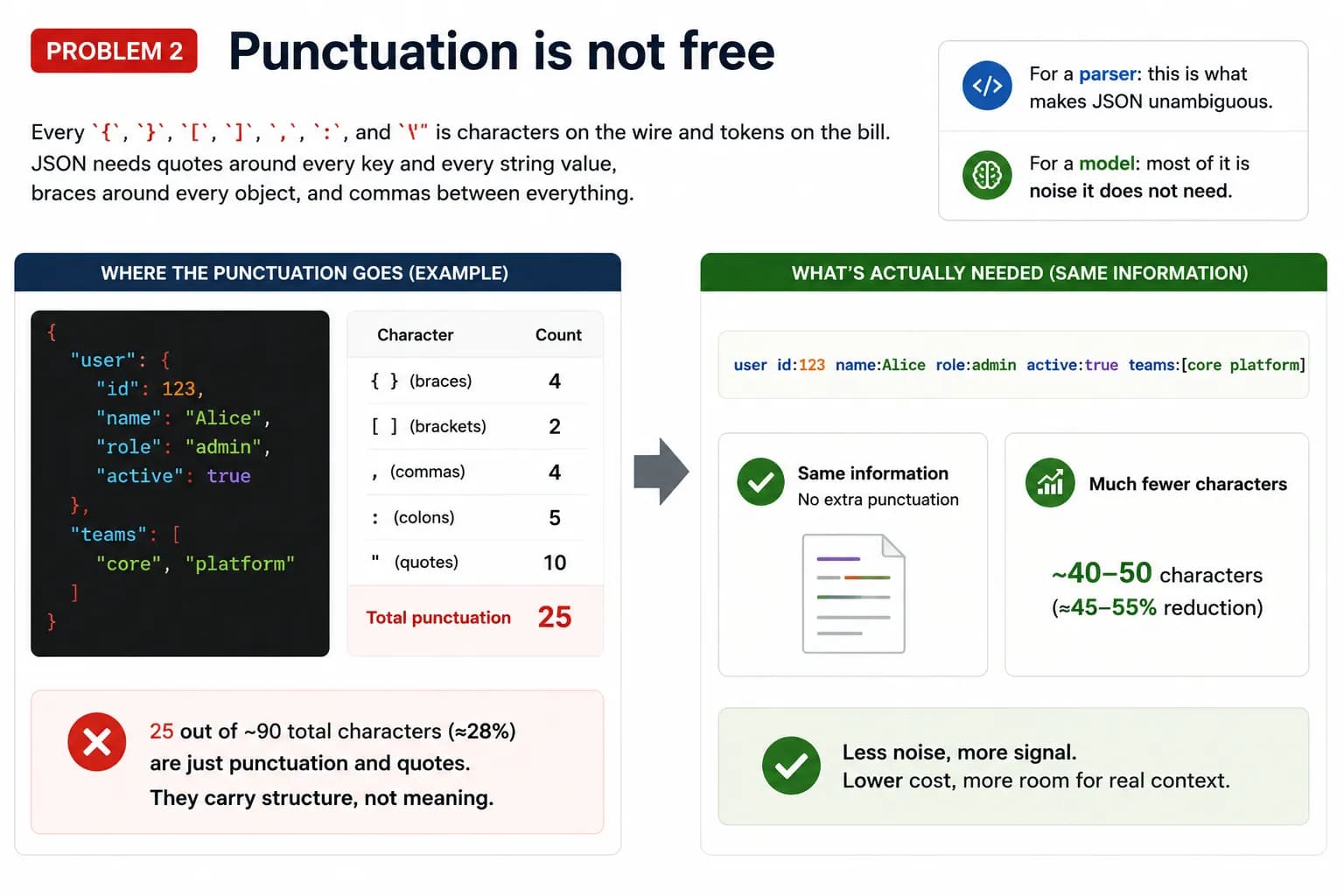
This snippet is 169 characters. The actual information in it—three IDs, three names, three roles, and the fact that they are users—is maybe 40 characters. The remaining 129 characters are structural syntax: curly braces, square brackets, quotes, colons, and repeated key names.
The Hidden Cost: How Tokenizers Read JSON
LLMs do not read characters; they read tokens. A token is a chunk of characters, usually averaging around four characters in English. However, syntax characters like `"`, `{`, `}`, and `:` do not always group nicely. They often split into individual tokens or fragment the actual data words.
In our JSON example, the key `"role"` is repeated three times. That is three times the LLM has to pay attention to, process, and generate the exact same structural label. When you scale this to a database export containing 500 rows, you are paying for thousands of redundant tokens just to tell the LLM where the columns are.
How does TOON fix the LLM data transfer problem?
 Hover to zoom
Let us look at how the exact same user list is represented in TOON format:
TOON (Token Object-Oriented Notation) fixes the LLM data transfer problem by stripping away structural redundancy and relying on indentation and clean type declarations. It is designed to be highly readable for both humans and language models while keeping token counts to an absolute minimum.
User
  id: Int
  name: Str
  role: Str

users: User[]
  1, Alice, admin
  2, Bob, user
  3, Chen, editor
This TOON representation is only 88 characters—almost a 50% reduction in raw character count. More importantly, it defines the schema once at the top (`User`), and then lists the raw values in a clean, tabular format. There are no repeated keys, no double quotes around every single string, and no nested braces.
JSON vs TOON: Token and Cost Comparison
To understand the economic impact of this shift, let us compare how JSON and TOON perform across different metrics when feeding data into GPT-4o or Claude 3.5 Sonnet.
| JSON (Standard) | TOON (Optimized) | |
|---|---|---|
| Syntax Overhead | Very High (brackets, quotes, colons) | Minimal (indentation, commas) |
| Schema Redundancy | Repeated on every single object | Defined once at the top |
| Token Efficiency | Poor (often 2-3x more tokens than data) | Excellent (near 1:1 data-to-token ratio) |
| LLM Parsing Accuracy | High (industry standard) | High (LLMs understand clean tables easily) |
| API Cost Impact | Standard pricing | Up to 40% cost reduction on payloads |
Why LLMs Understand TOON Without Training
You might wonder: if JSON is the global standard, will switching to TOON confuse the LLM? The answer is no. LLMs do not need JSON to understand structure. They are trained on massive amounts of code, including Python, YAML, CSV, and Markdown tables.
 Hover to zoom
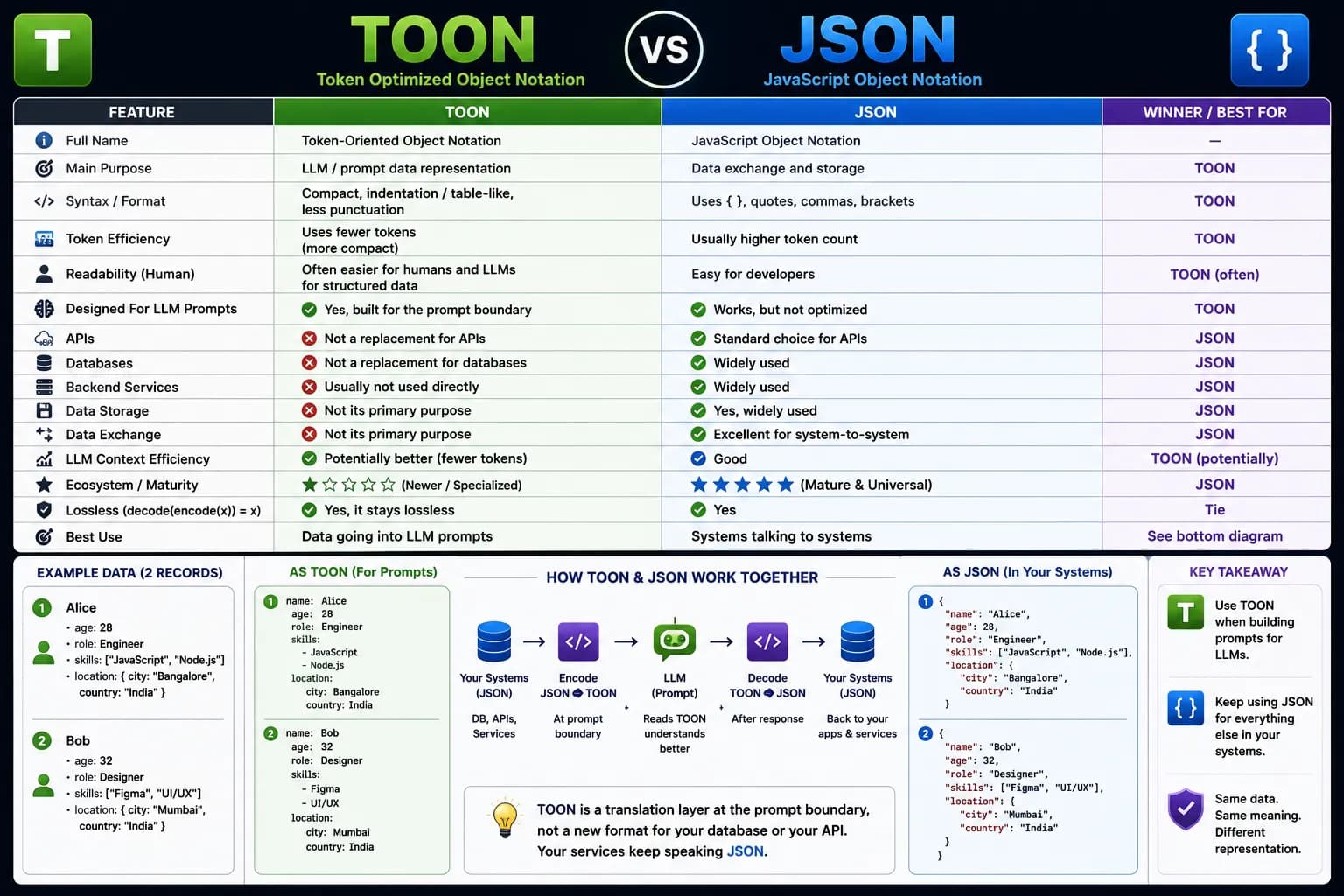
TOON leverages this pre-existing knowledge. It uses indentation (like Python) and comma-separated values (like CSV). Because the model already understands these concepts, it can parse and generate TOON perfectly without any special fine-tuning. You get faster response times, lower latency, and smaller bills.
Implementing TOON in Your AI Automation Pipeline
To integrate TOON into your application, you can use a simple two-step process. First, serialize your database objects into TOON format before sending them to the LLM prompt. Second, instruct the LLM to return its response in TOON format, which you then convert back to JSON for your internal systems.
- Define your data schema at the top of the prompt using TOON syntax.
- Pass the raw data rows without repeating key names.
- Instruct the LLM to output its response using the same schema structure.
- Parse the comma-separated values on your server to rebuild JSON objects for your database.
Conclusion: Is it time to drop JSON for AI?
JSON is not going away for traditional APIs, but for LLM data transfer, it is a costly legacy habit. When we compare json vs toon, the token savings speak for themselves. By adopting a minimalist, schema-first format like TOON, you can optimize your AI automation workflows, slash your API bills, and reduce latency. At Squarebrackets, we teach these production optimization techniques to ensure your AI systems are not just functional, but highly cost-effective.