

AI/Automation
Waterfall to Agentic SDLC: The Evolution of Software Engineering
Explore how software development evolved from rigid Waterfall and Agile cycles into the era of Agentic SDLC, where autonomous AI agents write, test, and deploy code.

 Hover to zoom
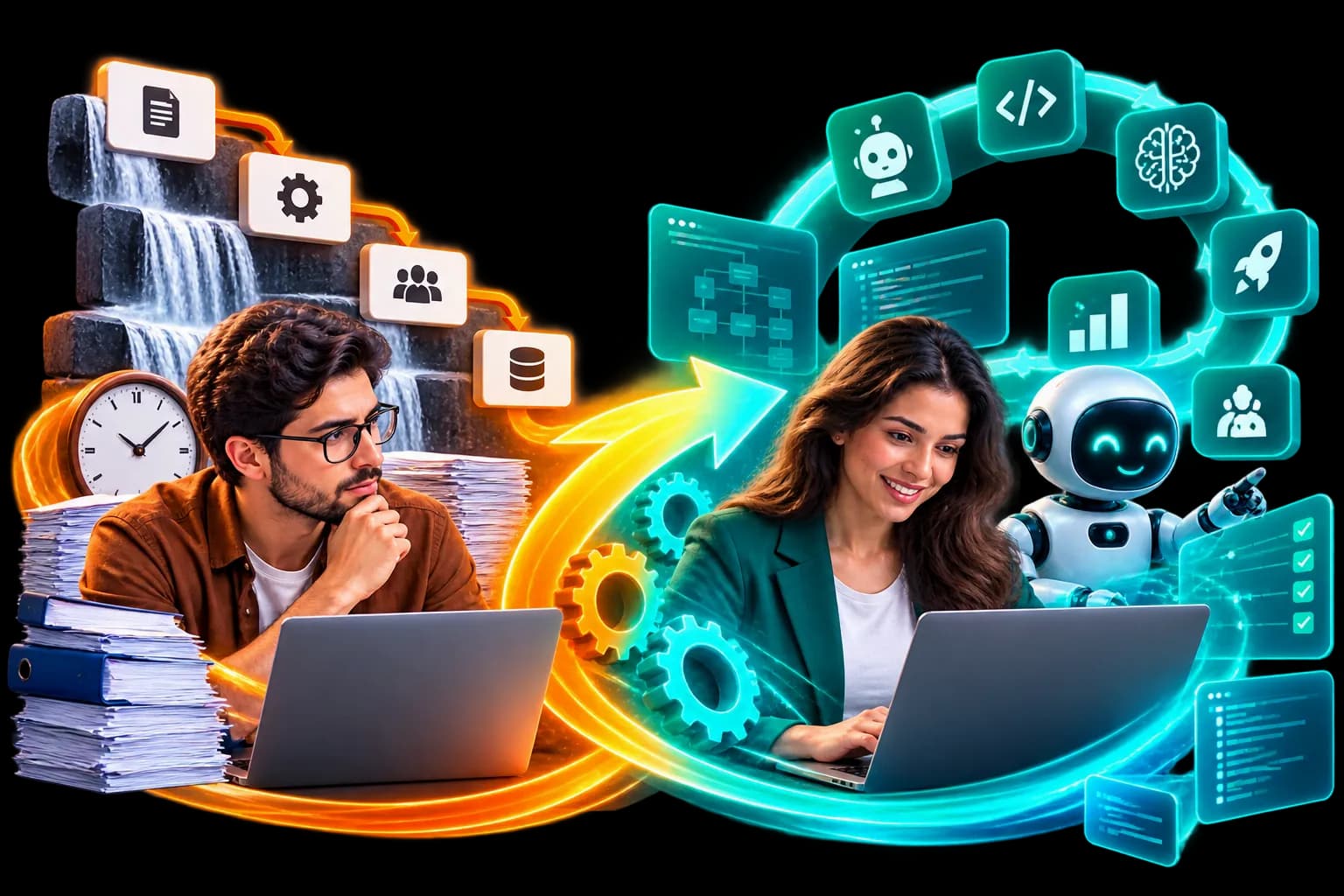
For decades, software engineering has been defined by structures, pipelines, and human constraints. As we move from Waterfall to Agentic SDLC: The Evolution of Software, we stand on the precipice of the most radical shift in engineering history, where autonomous AI agents collaborate to build, test, and deploy systems.
What was the traditional Waterfall model?
 Hover to zoom
The Waterfall model was inherited from physical manufacturing and civil engineering. In the 1970s, software development was treated like building a bridge: you designed everything upfront, built it, and hoped you did not need to change anything later. It was highly sequential, predictable, and incredibly slow.
A typical Waterfall project moved through strict, gated phases. Requirements were locked in a massive Word document. Designers drew blueprints. Programmers spent months writing code in isolation. Testers found bugs at the very end, and deployment was a high-stress weekend event that happened once a year. If a competitor launched a better feature mid-way, you could not pivot without scrapping millions of dollars of work.
The Agile Revolution and the DevOps Era
 Hover to zoom
In 2001, seventeen software developers met in Utah and drafted the Agile Manifesto. They prioritized individuals over processes and working software over documentation. This broke the massive, multi-year Waterfall projects into 2-to-4-week cycles called sprints.
But Agile had a major bottleneck: the wall between developers and operations. Developers wanted to push new features fast, while operations teams wanted system stability, leading to constant friction. This friction birthed DevOps. By introducing Continuous Integration and Continuous Deployment (CI/CD) pipelines, teams automated testing and infrastructure provisioning. Tools like Jenkins, Docker, and Kubernetes turned deployments from manual nightmares into automated, daily events.
| Waterfall Model | Agile & DevOps | |
|---|---|---|
| Release Cycle | 6 to 12 months or longer | 1 to 4 weeks (Sprints) |
| Feedback Loop | Very late, during testing phase | Continuous, after every commit |
| Risk Level | High; bugs found late are costly | Low; issues caught early in sprints |
| Infrastructure | Manual provisioning by IT operations | Infrastructure as Code (IaC) pipelines |
What is the Agentic SDLC paradigm?
 Hover to zoom
The agentic SDLC represents a shift from automation to autonomy. In the DevOps era, we automated repetitive tasks using hardcoded scripts like YAML files for GitHub Actions. In the agentic era, we delegate cognitive tasks to networks of specialized AI agents that can plan, execute, reason, and self-correct.
An AI agent is not just a chat window like ChatGPT that outputs code snippets. An agent is an autonomous loop. It receives a high-level objective (e.g., "Add a Stripe subscription billing system to our backend"), breaks it down into a list of tasks, writes the code, runs the local server, reads the compiler errors, fixes its own bugs, writes unit tests, and submits a pull request. It uses tools—like terminal access, web browsers, and file editors—just like a human engineer.
How does an Agentic Workflow operate in practice?
To understand how this works, look at a typical multi-agent orchestration. Instead of one giant model trying to do everything, we deploy a network of specialized agents. Each agent has a specific role, system prompt, and set of tools.
- Product Manager Agent: Parses a loose user request, checks the existing codebase architecture, and writes a structured feature specification.
- Architect Agent: Decides which design patterns, database schemas, and API endpoints are required.
- Coder Agent: Generates the actual implementation code in the workspace files.
- QA Agent: Automatically generates unit tests, runs them in a sandboxed container, and feeds any stack traces back to the Coder Agent for debugging.
- Security Agent: Scans the newly written code for vulnerabilities like SQL injection or hardcoded API keys before approving the pull request.
Example: Simulating an Agentic Debugging Loop
Below is a conceptual Python representation of how an autonomous agent uses a planning loop to fix a broken API endpoint. It does not just write code; it evaluates the execution output and iterates until the test passes.
import subprocess

class DebuggingAgent:
    def __init__(self, file_path):
        self.file_path = file_path
        self.max_attempts = 3

    def run_tests(self):
        # Run pytest and capture output
        result = subprocess.run(["pytest", self.file_path], capture_output=True, text=True)
        return result.returncode == 0, result.stdout

    def modify_code(self, error_logs):
        # In a real agent, this calls an LLM API with the error logs to get a code fix
        print("[Agent] Analyzing error logs and patching code...")
        # Simulated patch logic
        with open(self.file_path, "w") as f:
            f.write("def add(a, b): return a + b  # Fixed type mismatch bug\n")

    def resolve_issue(self):
        for attempt in range(1, self.max_attempts + 1):
            print(f"\n[Attempt {attempt}] Running test suite...")
            success, logs = self.run_tests()

            if success:
                print("[Success] Code is clean and all tests passed!")
                return True

            print(f"[Failed] Found errors. Sending logs to LLM engine...")
            self.modify_code(logs)

        print("[Error] Agent could not resolve the issue within limits. Escalating to human.")
        return False

# Instantiate and run the agent loop
# agent = DebuggingAgent("test_math_api.py")
# agent.resolve_issue()
The Impact of Agentic SDLC on the Tech Industry
The implications of this shift are massive. First, the cost of prototyping drops to near zero. A single developer can act as a CTO, managing an entire team of virtual engineers to build complex, multi-service applications in days instead of months. For a deeper look into the differences between paradigms, read our guide on Agentic AI vs Generative AI: How to Start Learning in 2026, and review our breakdown on Prompt Engineering to Harness Engineering: AI Development Evolution.
Second, the nature of entry-level software engineering jobs is changing. Companies will no longer hire juniors to write simple boilerplates or manually translate designs into CSS. Instead, engineering education must focus on system design, security, code review skills, and prompt orchestration. Through structured tracks like the Generative AI Course and the Agentic AI Software Engineering: Build & Deploy Production Agents course, we teach students how to manage AI agents, write comprehensive test suites, and audit AI-generated code bases.
Preparing for the Agentic Future
The evolution of software development is a story of continuous abstraction. We moved from punch cards to assembly language, from compilers to high-level frameworks, and from manual servers to cloud containers. The transition to an agentic SDLC is the next logical step in this journey.
Engineers who resist this change risk becoming obsolete, while those who learn to orchestrate AI agents will build at unprecedented speeds. The future belongs to the developers who can design systems, write bulletproof tests, and guide autonomous agents to do the heavy lifting.