

AI/Automation
Vector Embedding Explained: The Math Behind Modern AI
Demystify vector embeddings, how they represent real-world data as high-dimensional coordinates, and how LLMs use them to understand semantic meaning.

 Hover to zoom
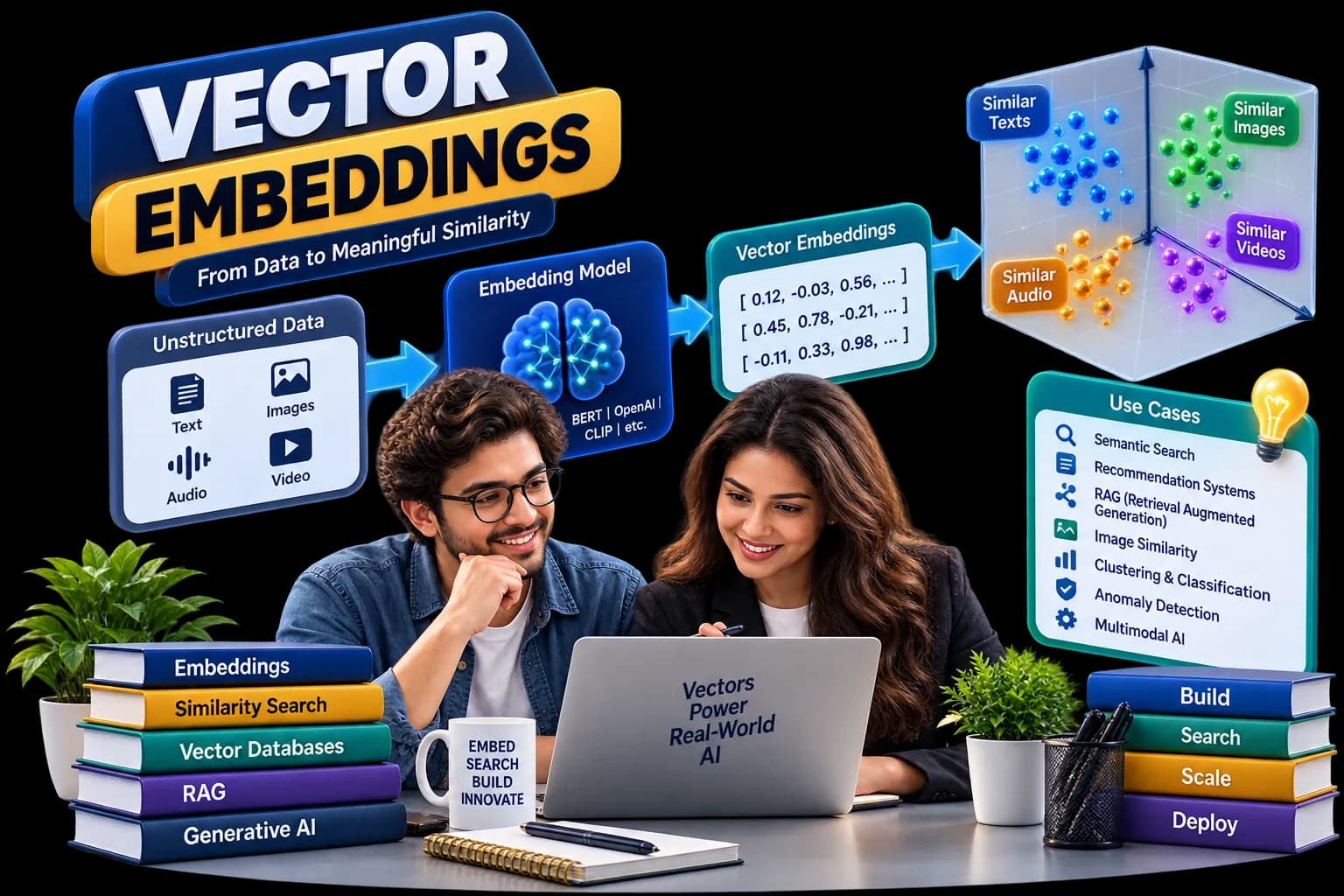
If you have ever wondered how AI applications instantly understand what you mean rather than just matching words, you need to understand Vector Embedding Explained: The Math Behind Modern AI. If you have built modern search bars or recommendation engines, you already know that computers cannot read English or parse images directly. They require numbers. To bridge this gap, AI engineers use vector embeddings to translate abstract concepts into lists of floating-point numbers that machines can calculate efficiently.
In this guide, we will get vector embedding explained in plain, developer-friendly language. We will look at how they work under the hood, how they represent semantic meaning, and how you can generate your own using Python. If you are building modern applications, understanding these concepts is essential before enrolling in our comprehensive Generative AI Course or mastering practical Machine Learning pipelines.
What is a Vector Embedding?
A vector embedding is a numerical representation of data—words, sentences, images, or audio—stored as a point in a high-dimensional space. Instead of treating words as isolated strings of characters, embeddings place them in a coordinate system where items with similar meanings are positioned close to one another.
Think of a simple 2D map. If we map cities, Paris and Rome will sit close to each other because they are both historic European capitals. Tokyo will be far away. Now, imagine a map with 1,536 dimensions. Instead of just latitude and longitude, each axis represents a specific abstract concept like "royalty," "tense," "gender," or "temperature." That is a modern vector embedding space.
How Do Vectors Capture Semantic Meaning?
To understand how this works, let's look at a simplified 3-dimensional embedding space. Imagine we have three dimensions representing: Royalty, Gender (Masculine), and Age (Youth). We can assign values between -1.0 and 1.0 for each concept.
| Word | Dimension 1: Royalty | Dimension 2: Masculinity | Dimension 3: Youth | Vector Representation |
|---|---|---|---|---|
| King | 0.95 | 0.90 | -0.20 | [0.95, 0.90, -0.20] |
| Queen | 0.95 | -0.90 | -0.15 | [0.95, -0.90, -0.15] |
| Prince | 0.90 | 0.85 | 0.80 | [0.90, 0.85, 0.80] |
| Boy | -0.10 | 0.80 | 0.90 | [-0.10, 0.80, 0.90] |
Notice how "King" and "Queen" score almost identically on Royalty, but are polar opposites on Masculinity. Because their vectors are mathematically similar, a search algorithm can instantly deduce that a King and a Queen are related concepts, even if they do not share any of the same letters.
How Do Vector Embedding Models Work?
Vector embedding models are trained on massive datasets using deep neural networks. During training, the model is exposed to billions of sentences and learns the relationships between words based on context. The core philosophy here was famously summarized by linguist John Rupert Firth: *"You shall know a word by the company it keeps."*
Early models like Word2Vec (developed by Google in 2013) looked at local context windows to predict words. Today's advanced transformer models, such as BERT, RoBERTa, and OpenAI's embedding models, use self-attention mechanisms to generate context-aware embeddings. This means the word "bank" will have a different vector representation in "river bank" than it does in "investment bank."
You do not need a PhD in mathematics to generate and use vector embeddings. Libraries like Hugging Face's `sentence-transformers` make it incredibly straightforward to run these models locally on your machine.
# First, install the library:
# pip install sentence-transformers

from sentence_transformers import SentenceTransformer
from sklearn.metrics.pairwise import cosine_similarity

# Load a lightweight, highly efficient model
model = SentenceTransformer('all-MiniLM-L6-v2')

# Define our sample sentences
sentences = [
    "The cat chased the mouse across the kitchen floor.",
    "A feline ran after a tiny rodent inside the house.",
    "Deploying a Kubernetes cluster to AWS cloud infrastructure."
]

# Generate the embeddings (this returns a list of numpy arrays)
embeddings = model.encode(sentences)

# Let's inspect the shape of the first vector
print(f"Vector shape: {embeddings[0].shape}")
# Output: Vector shape: (384,)

# Calculate similarity between the cat sentences
sim_cat_feline = cosine_similarity([embeddings[0]], [embeddings[1]])[0][0]
# Calculate similarity between a cat sentence and a tech sentence
sim_cat_tech = cosine_similarity([embeddings[0]], [embeddings[2]])[0][0]

print(f"Similarity (Cat vs Feline): {sim_cat_feline:.4f}")
print(f"Similarity (Cat vs AWS): {sim_cat_tech:.4f}")
If you run this script, you will notice that even though "cat" and "feline" use entirely different words, their similarity score will be high (often above 0.75). Conversely, the similarity score between the cat sentence and the AWS deployment sentence will be close to zero.
Vector embeddings are the foundational building blocks for several modern AI applications. They allow developers to build search systems that understand user intent rather than just matching exact keywords.
Vector embeddings are the foundational building blocks for several modern AI applications. They allow developers to build search systems that understand user intent rather than just matching exact keywords.
- Retrieval-Augmented Generation (RAG): When you ask a custom AI chatbot a question, your query is converted to an embedding. The system searches a vector database for relevant documentation vectors and feeds that context to an LLM to generate an accurate, hallucination-free response.
- Recommendation Engines: Spotify, Netflix, and Amazon embed your past behavior (items purchased, songs skipped) into a vector. They recommend items whose vector coordinates lie closest to your profile vector.
- Anomaly Detection: In cybersecurity, network traffic patterns can be mapped as vectors. Patterns that lie far away from the clustered 'normal' behavior vectors are instantly flagged as potential security breaches.
- Multimodal Search: Models like CLIP generate embeddings where text and images share the same vector space. This allows you to search for images using natural language queries like 'dog playing frisbee in the rain' without any manual image tagging.
Sparse vs. Dense Embeddings: What's the Difference?
When building search systems, you will often hear about sparse and dense vectors. They serve different purposes, and modern search engines often combine both for optimal performance.
| Sparse Vectors (e.g., BM25, TF-IDF) | Dense Vectors (e.g., BERT, OpenAI) | |
|---|---|---|
| Representation | High-dimensional with mostly zero values | Fixed-dimensional packed with real numbers |
| Search Type | Exact keyword matching | Semantic and conceptual matching |
| Strengths | Excellent for serial numbers, product IDs, and rare jargon | Excellent for handling synonyms, context, and multi-lingual queries |
| Weaknesses | Fails if users use different words for the same concept | Can sometimes hallucinate relevance for completely unrelated terms |
The Role of Vector Databases
Standard relational databases like MySQL or PostgreSQL are optimized for matching rows based on exact matches or ranges. They are not built to calculate the distance between a query vector and millions of 1536-dimensional vectors in real-time.
This is where vector databases come in. Databases like Pinecone, Milvus, and Qdrant use specialized indexing algorithms like Hierarchical Navigable Small World (HNSW) to organize vectors into cluster graphs. This allows the system to perform approximate nearest neighbor (ANN) searches in milliseconds, even when querying billions of data points.
Production Reality: What Breaks at Scale?
Having a clear vector embedding explained helps you understand how modern AI systems bridge the gap between human language and machine computation. To master building enterprise retrieval systems, vector databases, and multi-agent workflows, explore the Production-Grade Generative AI and Agentic AI Engineer Program for hands-on labs and expert mentorship.