

Placement Ready
Generic Tree Interview Questions: Roadmap by Core Coding Techniques
Master N-ary and generic tree interview questions. This technical roadmap breaks down traversal, serialization, and recursion techniques with real-world coding patterns.

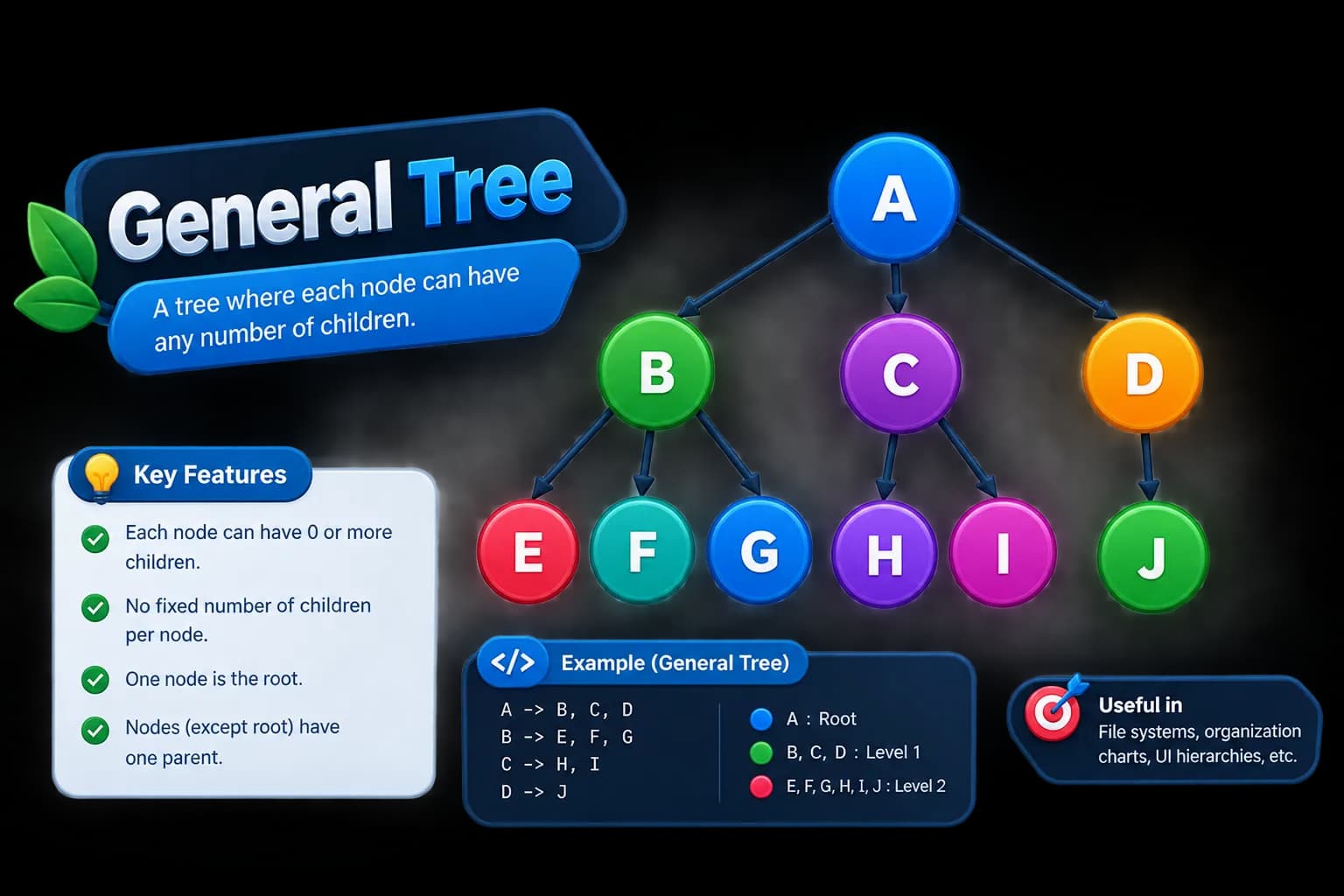 Hover to zoom
At Squarebrackets, we have analyzed hundreds of technical interviews at top-tier product companies. We noticed that generic tree problems fall into four distinct coding techniques. Master these four patterns, and you can solve almost any N-ary tree problem thrown at you.
What is a Generic Tree and Why Do Interviewers Love It?
A generic tree (or N-ary tree) is a hierarchical data structure where each node can have zero or more children. Unlike binary trees, you cannot hardcode `.left` and `.right` pointers. Instead, you must iterate over a collection of children, which makes your code more dynamic and less prone to copy-paste patterns.
Interviewers love generic trees because they test your ability to write clean loops inside recursive functions. They also mirror real-world systems. File directories, XML/JSON parsers, and organizational charts are all modeled as generic trees, not binary trees.
Technique 1: The Iterative Loop DFS (Depth-First Search)
import java.util.List;
import java.util.ArrayList;

public class NaryTreeTraversal {
    public static class Node {
        public int val;
        public List<Node> children;

        public Node(int _val) {
            val = _val;
            children = new ArrayList<>();
        }
    }

    public void preorder(Node root, List<Integer> result) {
        if (root == null) return;
        result.add(root.val);
        for (Node child : root.children) {
            preorder(child, result);
        }
    }
}
This technique is the foundation for several classic generic tree interview questions. Here are the primary questions you should practice using this technique:
- N-ary Tree Preorder Traversal — Process the root, then recursively process each child from left to right.
- N-ary Tree Postorder Traversal — Recursively process all children first, then process the root node.
- Maximum Depth of N-ary Tree — Find the longest path from the root node down to the farthest leaf node.
Technique 2: Level-Order Traversal (BFS)
Breadth-First Search on a generic tree uses a Queue. The main difference from a binary tree BFS is how we populate the queue for the next level. Instead of offering just left and right children, we run a loop to offer all non-null children of the current node.
Practice this technique with these high-frequency interview questions:
- N-ary Tree Level Order Traversal — Return the level-by-level representation of node values as a list of lists.
- Find Largest Value in Each Tree Row — Track the maximum value encountered at each horizontal level of the tree.
Technique 3: Bottom-Up Recursion (Post-Order Processing)
Some problems cannot be solved by simply passing information down. You need your children to return their results to you, aggregate those results, and pass the aggregated value up to your parent. This is bottom-up recursion.
| Top-Down DFS | Bottom-Up Recursion | |
|---|---|---|
| State Flow | Passed down via function arguments. | Returned up via function return values. |
| Decision Maker | Parent node decides the state of children. | Parent aggregates decisions made by children. |
| Typical Problems | Path sum, finding target node. | Diameter, subtree evaluation, LCA. |
This technique is crucial for advanced tree problems where relationships between nodes dictate the final output. Master these questions to solidify your bottom-up recursion skills:
- Lowest Common Ancestor of a Binary Tree — Adapt this logic for an N-ary tree by checking how many children return non-null values.
- Subtree of Another Tree — Verify if a tree matches a subtree structure by verifying structural equality bottom-up.
Technique 4: Serialization and Deserialization
How do you store a generic tree in a file or transmit it over a network? Because the number of children is dynamic, you cannot simply write out the values in preorder. You must also encode the structure (e.g., the number of children each node has, or a delimiter to close a level).
For example, you can serialize a tree by saving each node's value followed by the count of its children. During deserialization, read the value, read the child count, and recursively build that exact number of children.
- Serialize and Deserialize N-ary Tree — Design an algorithm to convert an N-ary tree to a string and parse it back to the original tree.
- Encode N-ary Tree to Binary Tree — Learn the left-child right-sibling representation to store a generic tree as a standard binary tree.
Summary of Generic Tree Coding Patterns
| Technique | Primary Auxiliary Space | Key Loop Construct | Best Used For |
|---|---|---|---|
| Iterative/Recursive DFS | O(Height) of call stack | for (Node child : node.children) | Preorder/Postorder traversals, path checks |
| Queue-Based BFS | O(Width) of the tree | while (!queue.isEmpty()) | Level-order, shortest path, level averages |
| Bottom-Up Recursion | O(Height) | Aggregate loop return values | LCA, diameter, subtree property validation |
| Serialization | O(N) space for output | DFS with structure markers | Data transmission, deep copying trees |
Mastering generic tree interview questions is all about shifting your mindset from binary pointers to collection-based iterations. Once you feel comfortable looping through a list of child nodes inside your recursive calls, these problems become as predictable as standard binary tree traversals. If you want hands-on mentoring and live practice on these data structures, check out our Data Structures and Algorithms using Java course.
If you are preparing for technical interviews and want structured problem-solving frameworks, explore our 100 Days of DSA with Java tutorial.