

Data Structures and Algorithms
Tree Data Structure Explained: Types and Real-World Use Cases
Understand tree data structures, their different types, segment trees, and real-world software engineering use cases from database indexing to range queries.

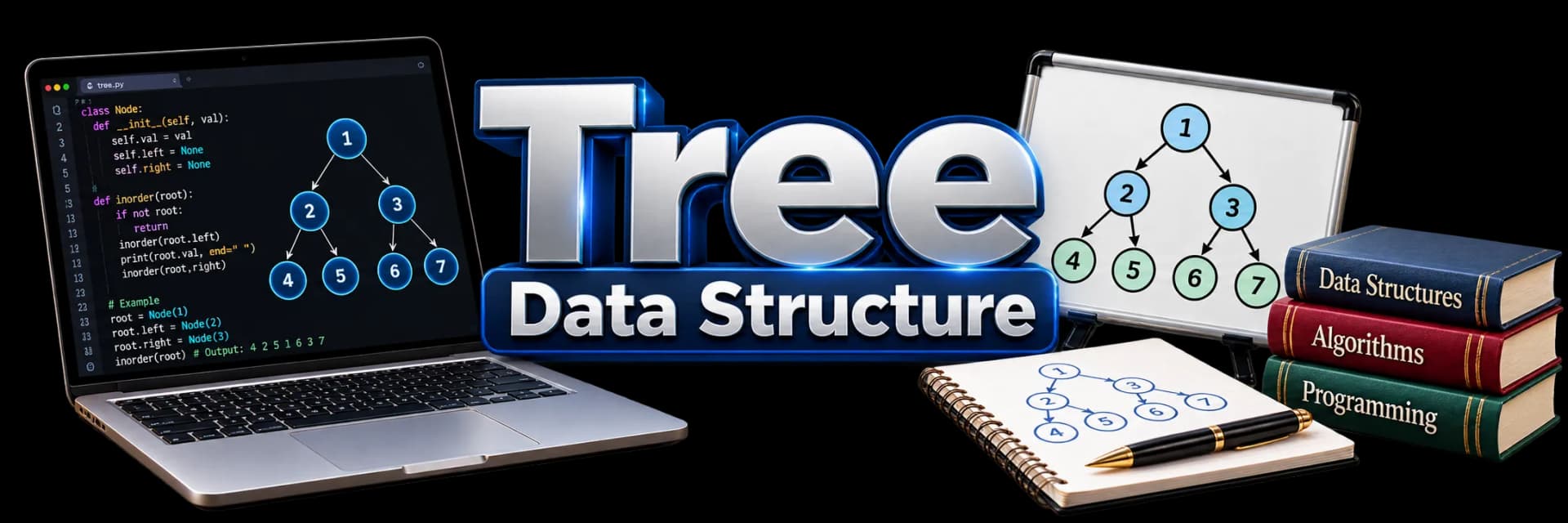 Hover to zoom
You push your code to production, and the database query that used to return in milliseconds suddenly spikes to four seconds. When investigating the bottleneck, you quickly realize the culprit is an unindexed table scanning millions of rows sequentially rather than using balanced tree pointer nodes. Understanding a tree data structure explained: types and real-world use cases is essential for any backend engineer diagnosing such performance degradation.
Mastering hierarchical data structures is essential for systems engineering, database internals, and writing efficient algorithms. If you are preparing for technical rounds, practice with the roadmap in Generic Tree Interview Questions: Roadmap by Core Coding Techniques or explore structured curricula like the Data Structures and Algorithms using Java course to build a bulletproof problem-solving foundation.
What is a Tree Data Structure?
A tree data structure is a non-linear collection of elements organized hierarchically into a root node, branching parent nodes, and leaf nodes. Unlike arrays or linked lists where data flows in a single line, a tree models parent-child relationships. Every node contains a value and references to its children.
To understand how data flows through these nodes, look at the standard structural layout below:
The root sits at the very top with no parents. Nodes with no children are called leaves. The depth of a node measures its distance from the root, while the height of the tree measures the longest path from the root down to any leaf. These metrics dictate the time complexity of every operation you perform on the structure.
General Trees and N-Ary Structures
Unlike binary trees which restrict children, a general tree or N-ary tree allows each node to possess an arbitrary number of children. You encounter these daily when traversing file directories, organizational hierarchies, or parsing Abstract Syntax Trees in compilers. Handling these structures requires storing children inside a dynamic list rather than fixed left and right pointers.
To practice general trees for technical interviews, solving problems that map parent-child arrays or serialize hierarchical structures is vital. A classic problem testing this capability is N-ary Tree Preorder Traversal and N-ary Tree Level Order Traversal, where you manage multi-child queues and recursive depth calls.
Binary Trees and Their Core Types
A binary tree restricts every parent node to a maximum of two children, traditionally designated as left and right. This constraint makes recursive processing straightforward, serving as the foundation for specialized variations across systems programming.
Different structural properties define sub-types of binary trees. A Full Binary Tree requires every node to have either zero or two children. A Complete Binary Tree fills every level completely from left to right except possibly the last. A Perfect Binary Tree has all internal nodes filled and all leaves at identical depth.
To master binary tree variations, practice fundamental questions that test structural manipulation. Essential problems include Maximum Depth of Binary Tree for recursion practice, Invert Binary Tree for pointer swapping, and Binary Tree Level Order Traversal for queue-based breadth-first processing.
Comparison of All Types of Binary Trees
Choosing the correct binary tree variant depends entirely on the operational guarantees you need for search, insertion, and memory overhead. The following comparison contrasts structural properties, balancing mechanisms, and performance profiles across all major binary tree types:
| Full & Complete Binary Trees | Binary Search Trees (BST) | |
|---|---|---|
| Structural Rule | Every node has 0 or 2 children (Full); filled level by level (Complete). | Left child value < parent value < right child value for all nodes. |
| Self-Balancing | No implicit balancing guarantees; maintained via array indices or pointers. | Unbalanced by default; can degenerate to a linear linked list O(n). |
| Search Time Complexity | O(n) because elements are not ordered by magnitude. | O(log n) average, degrading to O(n) in worst-case scenarios. |
| Primary Application | Binary heaps, priority queues, and compact array representations. | In-memory symbol tables, dictionary sets, and foundational searching. |
Continuing the comparison with self-balancing variations reveals how production software avoids the worst-case linear degeneration of standard BSTs:
| AVL Trees | Red-Black Trees | |
|---|---|---|
| Balancing Invariant | Height difference between left and right subtrees of any node is at most 1. | Color-based rules ensuring no path is more than twice as long as another. |
| Rotation Overhead | High rotation frequency during writes due to strict height constraints. | Low rotation frequency; relaxes height constraints for faster writes. |
| Read vs Write Profile | Optimized for read-heavy workloads requiring guaranteed minimum depth. | Balanced profile ideal for general-purpose mutable collections. |
| Production Use Case | In-memory databases and lookup tables with infrequent updates. | Java TreeMap, TreeSet, and C++ std::map container internals. |
AVL Trees and Strict Self-Balancing
When insertions arrive in sorted order, a standard Binary Search Tree degrades into a linked list, sending search time from logarithmic to linear. AVL Trees solve this by enforcing a strict balancing invariant: the height difference between the left and right subtrees of any node can never exceed one.
Whenever an insertion breaks this balance factor, the tree executes single or double rotations (Left-Left, Right-Right, Left-Right, Right-Left) to restore equilibrium in O(log n) time. Practicing balanced tree reconstruction prepares you for advanced systems challenges, aligned with problems like Balanced Binary Tree.
Red-Black Trees for Flexible Balancing
While AVL trees provide rigid height guarantees, their frequent rotational fixes can become expensive during write-heavy workloads. Red-Black Trees relax the balancing requirement by introducing node color attributes (red or black) and color-based rules that guarantee no path is more than twice as long as any other path.
Because they require fewer structural rotations during insertions and deletions, Red-Black trees power core library implementations like Java's `TreeMap` and `TreeSet`, as well as C++'s `std::map`. Understanding color-flip and rotation logic is essential for low-level memory management and kernel design, matching problems like Linked List Cycle II or advanced custom data structure implementations.
Segment Trees for Dynamic Range Queries
When you need to compute range minimums, sums, or maximums over an array that undergoes frequent element updates, linear scans become too slow. Segment Trees store pre-computed aggregate values in leaf and internal nodes, allowing both range queries and point updates to run in O(log n) time.
public class SegmentTree {
    private final int[] tree;
    private final int n;

    public SegmentTree(int[] arr) {
        n = arr.length;
        tree = new int[4 * n];
        build(arr, 0, 0, n - 1);
    }

    private void build(int[] arr, int node, int start, int end) {
        if (start == end) {
            tree[node] = arr[start];
        } else {
            int mid = (start + end) / 2;
            build(arr, 2 * node + 1, start, mid);
            build(arr, 2 * node + 2, mid + 1, end);
            tree[node] = tree[2 * node + 1] + tree[2 * node + 2];
        }
    }

    public int query(int l, int r) {
        return queryTree(0, 0, n - 1, l, r);
    }

    private int queryTree(int node, int start, int end, int l, int r) {
        if (r < start || end < l) return 0;
        if (l <= start && end <= r) return tree[node];
        int mid = (start + end) / 2;
        return queryTree(2 * node + 1, start, mid, l, r) +
               queryTree(2 * node + 2, mid + 1, end, l, r);
    }
}
In competitive programming and high-frequency trading data pipelines, segment trees handle dynamic streaming data efficiently. To build fluency with range aggregation, practice problems like Range Sum Query - Mutable, which requires building a segment tree array and propagating lazy updates.
Fenwick Trees (Binary Indexed Trees)
A Fenwick Tree, or Binary Indexed Tree, provides the same range-sum and point-update capabilities as a Segment Tree but uses half the memory and significantly less code complexity. It utilizes bitwise manipulation—specifically isolating the lowest set bit using `i & (-i)`—to navigate parent-child relationships in a flat array.
Fenwick trees are widely used in frequency counting, inversion counting algorithms, and compression pipelines. To master bitwise tree traversal, tackle problems like Count of Range Sum and Count of Smaller Numbers After Self.
Tries (Prefix Trees) for String Operations
Searching through millions of dictionary words or router routing tables using standard hash maps is inefficient for prefix matching. Tries store strings character by character along tree paths, allowing autocomplete and prefix searches to execute in O(m) time where m is the length of the word.
public class Trie {
    static class TrieNode {
        TrieNode[] children = new TrieNode[26];
        boolean isEndOfWord;
    }

    private final TrieNode root;

    public Trie() {
        root = new TrieNode();
    }

    public void insert(String word) {
        TrieNode current = root;
        for (char c : word.toCharArray()) {
            int index = c - 'a';
            if (current.children[index] == null) {
                current.children[index] = new TrieNode();
            }
            current = current.children[index];
        }
        current.isEndOfWord = true;
    }

    public boolean search(String word) {
        TrieNode current = root;
        for (char c : word.toCharArray()) {
            int index = c - 'a';
            if (current.children[index] == null) {
                return false;
            }
            current = current.children[index];
        }
        return current.isEndOfWord;
    }
}
Tries power predictive text engines, IP routing lookups, and spell checkers. To master prefix tree manipulation, solve Implement Trie and Word Search II, which combines backtracking with trie lookups.
Heaps and Priority Queues
A Heap is a complete binary tree that satisfies the heap invariant: in a Max-Heap, every parent is greater than or equal to its children, while in a Min-Heap, every parent is smaller. Heaps allow constant-time access to the extremum element and logarithmic-time insertions and extractions.
Heaps are implemented as compact arrays rather than pointer-linked objects, making them memory-efficient. They power scheduling algorithms, graph search algorithms like Dijkstra's, and stream processing. Practice essential problems like Kth Largest Element in an Array and Find Median from Data Stream using dual heaps.
Top 10 Essential Tree Interview Questions by Pattern
Technical interviews test tree data structures across ten distinct algorithmic patterns. Mastering these foundational problems prepares you for core data structure rounds at top product companies:
| # | Problem Name | Reference | Core Pattern |
|---|---|---|---|
| 1 | Maximum Depth of Binary Tree | LeetCode 104 | DFS Recursion |
| 2 | Invert Binary Tree | LeetCode 226 | Pointer Swapping / DFS |
| 3 | Binary Tree Level Order Traversal | LeetCode 102 | BFS / Queue Traversal |
| 4 | Validate Binary Search Tree | LeetCode 98 | BST Range Validation |
| 5 | Lowest Common Ancestor of a BST | LeetCode 235 | BST Property Search |
| 6 | Binary Tree Zigzag Level Order Traversal | LeetCode 103 | Modified BFS / Deque |
| 7 | Serialize and Deserialize Binary Tree | LeetCode 297 | Preorder / BFS Reconstruction |
| 8 | Implement Trie (Prefix Tree) | LeetCode 208 | Trie Node Chaining |
| 9 | Range Sum Query - Mutable | LeetCode 307 | Segment Tree / Range Aggregation |
| 10 | Kth Smallest Element in a BST | LeetCode 230 | In-order Traversal Property |
Understanding trees is the gateway to mastering advanced algorithmic design, graph theory, and database optimization. To apply these structures across different programming stacks, review the Data Structures and Algorithms using C & C++ course or follow the daily practice track in the 100 Days of DSA with Java tutorial.
To build practical problem-solving logic and master pointer manipulations, explore the Data Structures and Algorithms using Python course or practice daily with the 100 Days of DSA with Java tutorial.