

Data Structures and Algorithms
Queue Interview Roadmap: Grouped by Patterns and LeetCode Links
Master queue and deque interview questions categorized by core algorithmic patterns. Includes curated LeetCode links, code implementations, and key optimization tips for coding interviews.

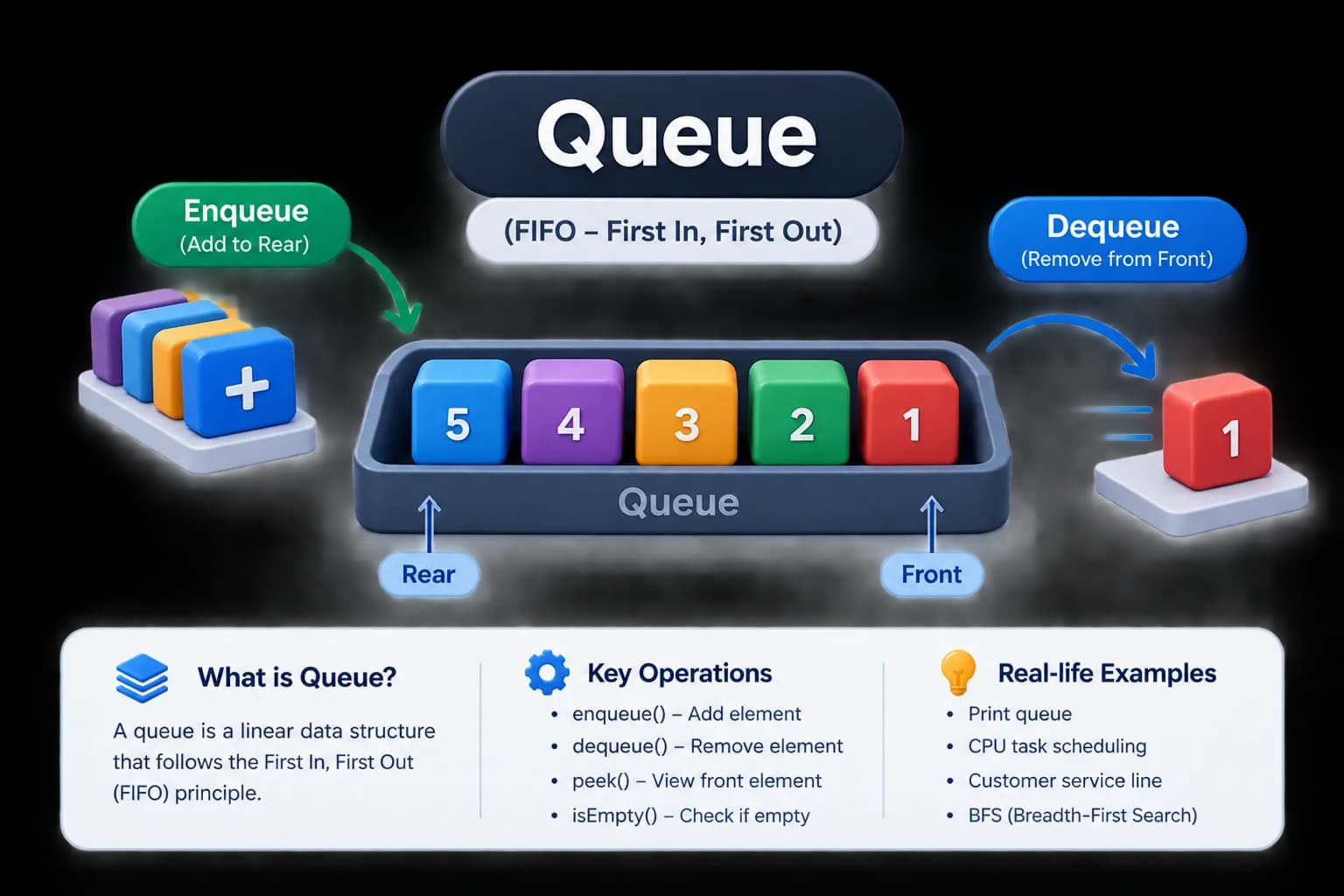 Hover to zoom
When you walk into a technical interview, stumbling on queue interview questions is usually the result of treating queues as simple First-In-First-Out storage units. Modern tech companies rarely ask you to just insert and delete from a queue. They expect you to recognize complex patterns like Monotonic Deques, Breadth-First Search level order traversals, and multi-state simulations. If you are preparing for top-tier product roles, mastering these problems systematically is the single best way to build confidence in your algorithms background.
Why do standard Queue implementations fail in interviews?
Understanding the internal mechanics of a queue is what separates junior engineers from candidates who ace senior technical loops. When you rely on naive data structures like dynamic arrays without considering their time complexity penalties, your solution will time out on large test cases. The implementation below shows how to build a robust queue using two stacks, guaranteeing amortized constant time operations.
import java.util.Stack;

public class QueueUsingStacks<T> {
    private final Stack<T> inputStack = new Stack<>();
    private final Stack<T> outputStack = new Stack<>();

    public void enqueue(T item) {
        inputStack.push(item);
    }

    public T dequeue() {
        shiftStacks();
        if (outputStack.isEmpty()) {
            throw new IllegalStateException("Queue is empty");
        }
        return outputStack.pop();
    }

    public T peek() {
        shiftStacks();
        if (outputStack.isEmpty()) {
            throw new IllegalStateException("Queue is empty");
        }
        return outputStack.peek();
    }

    private void shiftStacks() {
        if (outputStack.isEmpty()) {
            while (!inputStack.isEmpty()) {
                outputStack.push(inputStack.pop());
            }
        }
    }

    public boolean isEmpty() {
        return inputStack.isEmpty() && outputStack.isEmpty();
    }
}
Notice how the `shiftStacks` helper only transfers elements when the output stack is completely empty. This lazy evaluation ensures that each element is pushed and popped exactly twice across its lifecycle in the data structure, achieving an amortized O(1) time complexity per operation.
Pattern 1: The Monotonic Queue (Min/Max in Sliding Window)
Monotonic queues are specialized structures where elements are strictly increasing or decreasing from front to back. They allow you to solve sliding window maximum or minimum problems in linear time rather than quadratic time. When a new element enters the window, you continuously pop elements from the back of the deque that are smaller than the current element.
- LeetCode 239: Sliding Window Maximum
- LeetCode 1438: Longest Continuous Subarray With Absolute Diff Less Than or Equal to Limit
- LeetCode 862: Shortest Subarray with Sum at Least K
- LeetCode 2398: Maximum Number of Robots Within Budget
- LeetCode 918: Maximum Sum Circular Subarray
Pattern 2: Breadth-First Search Level Order Traversals
Breadth-First Search relies completely on the FIFO property of queues to process graph or tree nodes level by level. When building tree traversals or finding shortest paths in unweighted graphs, you queue the root node, pop it, and push all its children. This guarantees that nodes closer to the source are fully evaluated before moving deeper.
from collections import deque

class TreeNode:
    def __init__(self, val=0, left=None, right=None):
        self.val = val
        self.left = left
        self.right = right

def levelOrder(root: TreeNode) -> list[list[int]]:
    if not root:
        return []

    result = []
    queue = deque([root])

    while queue:
        level_size = len(queue)
        current_level = []

        for _ in range(level_size):
            node = queue.popleft()
            current_level.append(node.val)

            if node.left:
                queue.append(node.left)
            if node.right:
                queue.append(node.right)

        result.append(current_level)

    return result
Always capture the `level_size` right before looping through the current queue elements. If you omit this local variable and check `len(queue)` inside the loop directly while mutating the queue, your level boundary tracking will break entirely.
How do you choose between standard Queues and Deques?
Selecting the right variant prevents unnecessary performance degradation. Standard queues support single-end insertion and deletion, while double-ended queues offer constant-time modifications at both extremities. Knowing these trade-offs helps you pass architectural scrutiny during system design and algorithm rounds.
| Standard Queue (FIFO) | Double-Ended Queue (Deque) | |
|---|---|---|
| Insertion points | Rear only | Both front and rear |
| Deletion points | Front only | Both front and rear |
| Primary use case | Task scheduling, standard BFS | Sliding windows, monotonic algorithms |
| Time complexity | O(1) operations | O(1) operations at both ends |
Pattern 3: Multi-Source Breadth-First Search
Standard BFS starts from a single root node. Multi-source BFS pushes multiple initial starting points into the queue simultaneously before starting the traversal loop. This pattern is essential when solving grid propagation problems like rotting oranges or matrix zero distances.
import java.util.ArrayDeque;
import java.util.Queue;

public class MatrixDistance {
    public int[][] updateMatrix(int[][] mat) {
        int rows = mat.length;
        int cols = mat[0].length;
        int[][] dist = new int[rows][cols];
        Queue<int[]> queue = new ArrayDeque<>();

        for (int r = 0; r < rows; r++) {
            for (int c = 0; c < cols; c++) {
                if (mat[r][c] == 0) {
                    dist[r][c] = 0;
                    queue.offer(new int[]{r, c});
                } else {
                    dist[r][c] = -1;
                }
            }
        }

        int[][] dirs = {{-1, 0}, {1, 0}, {0, -1}, {0, 1}};
        while (!queue.isEmpty()) {
            int[] curr = queue.poll();
            int r = curr[0], c = curr[1];

            for (int[] d : dirs) {
                int nr = r + d[0], nc = c + d[1];
                if (nr >= 0 && nr < rows && nc >= 0 && nc < cols && dist[nr][nc] == -1) {
                    dist[nr][nc] = dist[r][c] + 1;
                    queue.offer(new int[]{nr, nc});
                }
            }
        }
        return dist;
    }
}
Initializing all zeroes into the queue at once treats them as a unified wave front. This ensures that every cell calculates its shortest distance to the nearest zero in a single pass, avoiding redundant traversals.
Production Reality: Performance Pitfalls and Memory Management
In production software systems, unbounded queues are dangerous. If a worker service goes down while a producer keeps pushing events into an in-memory queue, your JVM heap or Node process will run out of memory and crash. Always configure backpressure or bounded capacity limits when implementing queues for event-driven systems.
Common Mistakes Candidates Make with Queues
Interviewers frequently watch out for specific recurring bugs when testing linear data structures. Being aware of these traps helps you avoid silent logic errors under interview pressure.
- Using Python lists as queues with `pop(0)`, which forces an O(N) array shift on every operation.
- Forgetting to check if the queue is empty before calling peek or pop, causing runtime exceptions.
- Modifying queue sizes dynamically inside traversal loops without caching the initial boundary size.
- Ignoring thread safety when multiple consumer threads pull from a shared queue structure.
Where to go from here
Mastering these queue patterns requires looking past simple data insertion and recognizing the architectural mechanics behind them. If you want a structured, end-to-end curriculum that covers everything from foundational arrays to advanced system design, take a look at the Data Structures and Algorithms using Java course. For further practice on linear data structures, review the Linked List Interview Roadmap: 41 Questions in 11 Patterns and the Stack Interview Questions Grouped by Technique. Focus on understanding these core patterns, write clean code, and keep track of your space complexities to ace your next technical round.