
Azure AI, DevOps & Architect Certifications Courses
Live online Azure certification courses on two tracks: AI (AI-900/AI-901, then AI-102 and AI-500) and architecture and DevOps (AZ-305, then AZ-400), with hands-on labs in Azure OpenAI, YAML pipelines, Bicep and AKS.
4 courses
 Know more
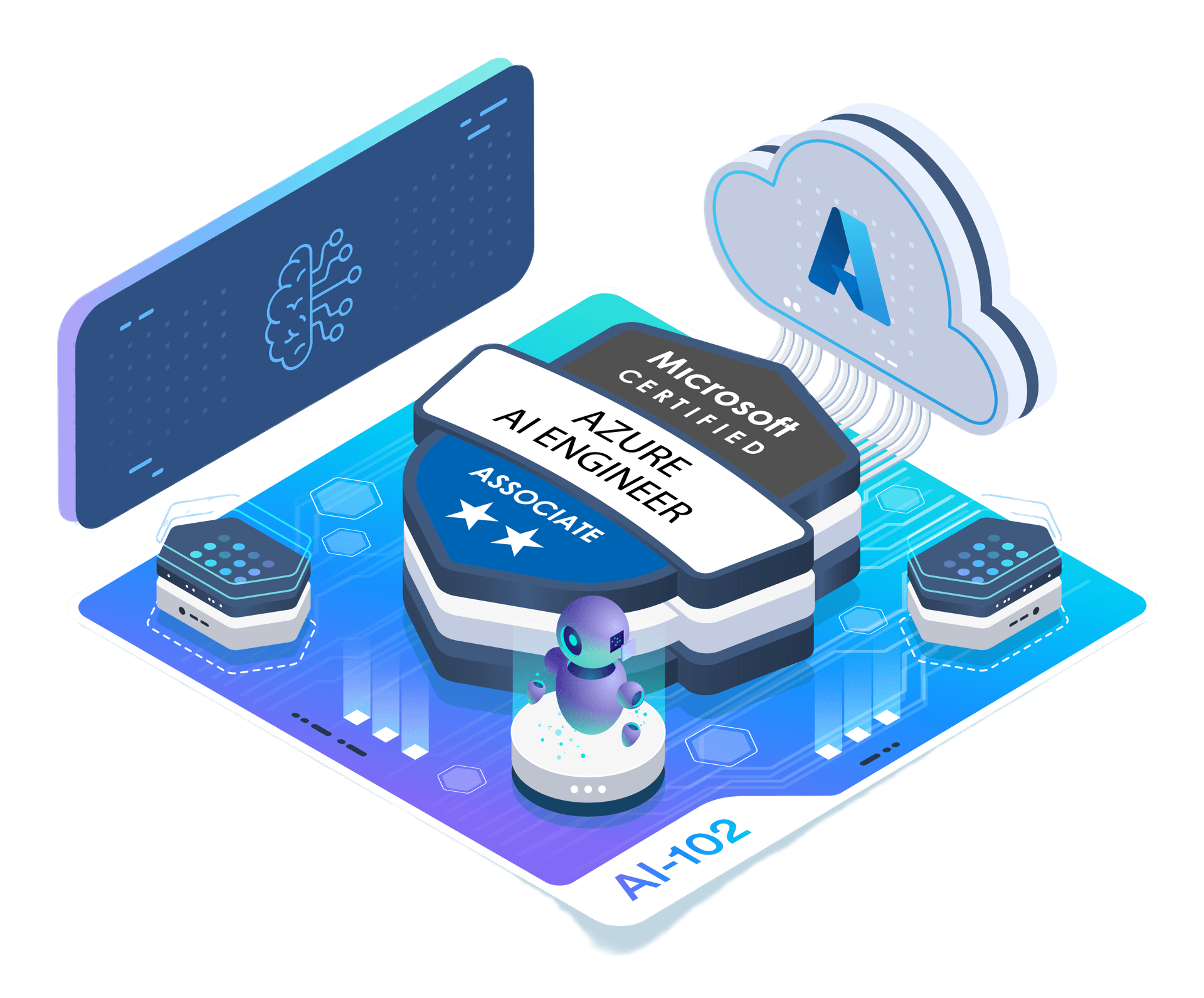
Microsoft Azure AI Engineer Associate (AI-102) Certification Training
 Know more
Microsoft Azure DevOps Solutions Architect (AZ-400)
 Know more
Microsoft Azure Solutions Architect AZ-305 Certification Training
 Know more
Microsoft Azure AI-500 Certification Course
About Azure AI, DevOps & Architect Certifications at Squarebrackets
A team ships a chatbot on Azure OpenAI in a fortnight, then spends a month working out why it surfaces internal documents, why the release pipeline needs an approval nobody remembers to give, and who pays the token bill. This category exists for that second month. Our Azure certification training covers the two jobs underneath it. The first is building AI features by calling Azure's ready-made services (Azure OpenAI, Azure AI Search, Speech, Vision, Document Intelligence) from your own code and making them safe for customers. The second is laying out the Azure estate and shipping a Git commit to a running release without anyone clicking through the portal. Each course maps to a published Microsoft exam, so the badge on your profile matches what you can actually do.
It suits backend developers adding AI to an existing product, DevOps and site reliability engineers moving onto Azure from another cloud, and freshers who want a certification interviewers recognise. The fundamentals course assumes nothing beyond comfort with a computer and teaches the Python it needs. The associate and expert courses expect you to write Python or C# and read a REST call, or to already work daily with Git, a Linux shell and basic networking. If Git and the shell still feel shaky, the DevOps & Automation Bootcamp covers Linux, shell scripting and Git before you touch Azure, while engineers looking at multi-cloud setups often explore the AWS Cloud course or the Google Cloud (GCP) course.
The AI track runs in three steps, and fundamentals should come first even though the catalogue lists AI-102 at the top. Start with Azure AI Fundamentals (AI-900 / AI-901), four weeks that give you the vocabulary of models, prompts, agents and responsible AI before the associate exams assume it. Next, the AI-102 Azure AI Engineer course has you build against the APIs: vision, language, speech and knowledge mining with Azure AI Search. Finish with AI-500 enterprise AI training, where retrieval-augmented generation (RAG, which grounds a model's answers in your own documents), agents, fine-tuning and monitoring come together in a capstone. If your team writes code with AI assistants, the GitHub Copilot GH-300 and GH-600 program is a sensible step after that. For agent frameworks that live outside Azure, such as LangGraph and CrewAI, the production-grade generative and agentic AI program picks up where AI-500 stops, and those building comprehensive systems look at the Advanced AI-Driven Full-Stack Cloud Architect Program.
The infrastructure track is two courses, and here too the listed order is backwards: take AZ-305 before AZ-400, although neither is a formal prerequisite for the other. AZ-305 Solutions Architect training decides the shape of everything: identity and governance, data storage, business continuity and the Well-Architected Framework. The AZ-400 DevOps Solutions Architect course, which leads to Microsoft's DevOps Engineer Expert certification, then automates delivery onto that design, with CI/CD (the automation that builds, tests and ships your code) in multi-stage YAML pipelines, Bicep and Terraform for infrastructure as code, and deployments to Azure Kubernetes Service (AKS). Think of it as drawing the floor plan before installing the lifts, a workflow also expanded upon in the Advanced DevOps and Infrastructure Engineering Course. The parallel breaks in one place: on Azure you will redraw the plan many times, and the pipeline is what makes that cheap. Microsoft only awards the Expert badges if you also hold an associate certification such as AZ-104, which the Azure Cloud course prepares you for. Prefer AZ-900, AZ-305 and AZ-400 in one 24-week run? Take the combined Solutions Architect and DevOps Expert program.
The roles hiring for these skills are titled Azure AI engineer, cloud solutions architect, platform engineer and DevOps engineer, and they cluster at companies already on Microsoft 365 and Entra ID, where Azure is the default cloud. Interviewers rarely want a service list recited. They hand you a scenario: a pipeline that deployed a broken build, an Azure OpenAI endpoint returning HTTP 429 under load, a region going dark. Then they watch how you roll back, where you keep secrets (Key Vault, not pipeline variables), and how you'd notice the problem before a customer does. The certificate gets you the interview. The scenario round decides it.
Where to start comes down to the work on your desk this quarter. New to Azure and heading for AI work? Take AI-900 / AI-901. Coming to Azure with no cloud background but aiming at infrastructure? Begin with the Azure Cloud course and AZ-104, since the Expert badges need it anyway. Building product features while the team asks for chat, search or document extraction? Go to AI-102. Already own releases or infrastructure? Start at AZ-305, or at AZ-400 if the architecture is settled and your real problem is delivery. Cohorts run live online in IST for learners worldwide, and you'll break a real pipeline in front of an engineer who has fixed one. That's the part of Azure certification training a practice test can't give you.
About Azure AI, DevOps & Architect Certifications training at Squarebrackets
This category holds 4 programmes at intermediate and advanced level, from a 12 weeks intensive up to 10 weeks (80 hours). Each one is taught live by engineers who build production systems in the same technologies — which is the reason the syllabus tracks what teams actually run rather than what a textbook settled on three years ago.
Every programme is built around work you keep: something you can open in an interview, walk through line by line, and defend under questioning. You get the batch recordings for life, and placement support — resume review, LinkedIn optimisation, mock interviews and employer referrals — runs alongside the course rather than starting after it.
Not sure which of these fits? The free tutorials cover much of the same ground at your own pace and cost nothing, and the six questions worth asking any institute will tell you more than a comparison table will.
- Courses
- 4
- Levels
- Intermediate · Advanced
- Length
- 12 weeks – 10 weeks (80 hours)
- Mode
- Live online
Tools and technologies covered across these courses
- Azure OpenAI Service
- Azure AI Search
- Document Intelligence
- Azure AI Speech
- Azure Language Service
- Azure AI Vision
- Azure Bot Framework
- Python SDK
- Azure CLI
- Postman
- Azure DevOps
- Azure Boards
- Azure Repos
- Azure Pipelines
- Azure Artifacts
- GitHub Actions
- GitHub Advanced Security
- Bicep
Azure AI, DevOps & Architect Certifications course questions
Which Azure certification should I take first?
It depends on the track. For AI work, start with Azure AI Fundamentals (AI-900 / AI-901): four weeks, no cloud background assumed, and it covers the vocabulary AI-102 and AI-500 build on. For infrastructure, start with AZ-104 through the Azure Cloud course if Azure is new to you, or go to AZ-305 if you already run workloads there.
Do I need AZ-305 before AZ-400?
No, Microsoft doesn't require it, but we recommend it. AZ-305 decides the design: identity, storage, disaster recovery and compute. AZ-400 automates how code reaches that design from a Git commit. Each Expert badge also needs an Associate cert: AZ-104 for the architect badge, AZ-104 or AZ-204 for DevOps, so plan that in.
Is the AZ-400 exam hard without real DevOps experience?
Yes, mostly because the questions are scenarios, not definitions. You'll be asked which branching strategy, approval gate or deployment pattern fits a situation, and the wrong options all look plausible. People who have written a multi-stage YAML pipeline and broken it a few times tend to pass; people who only read the docs usually don't.
What do I need to know before starting?
For AI-900 / AI-901, nothing beyond comfort with a computer; the course teaches the Python you need for the Foundry SDK. For AI-102 and AI-500, write Python or C# confidently and know what a REST API call looks like. For AZ-305 and AZ-400, you should already work with Git, a Linux shell and basic networking.
How are the live online classes run?
Every cohort is live and taught by a working engineer, in timezone-friendly batches so you can keep your day job. Learners across Delhi NCR and worldwide join the same session. Labs use real Azure resources: depending on the course, you'll wire up Azure OpenAI, deploy to Azure Kubernetes Service (AKS) or debug a failing pipeline yourself.
Do the courses prepare me for the official Microsoft exams?
Yes. Each course maps its modules to the published skills outline for its exam and finishes with scenario practice in the exam's style. Training doesn't replace the exam itself: you book and sit it through Microsoft. Associate and Expert certifications also need a free online renewal assessment every year, so the learning doesn't stop at the pass.
Should I choose the AI track or the DevOps track?
Follow the work you already do. If you build features and your team wants chat, search or document extraction, take the AI track through AI-102 and AI-500. If you own releases and infrastructure, take AZ-305 then AZ-400. Doing both is reasonable, but finish one track first; switching midway leaves two half-built skill sets.
How many Azure AI, DevOps & Architect Certifications courses does Squarebrackets offer?
4 at the moment, spanning intermediate and advanced levels. They include Microsoft Azure AI Engineer Associate (AI-102) Certification Training, Microsoft Azure DevOps Solutions Architect (AZ-400) and Microsoft Azure Solutions Architect AZ-305 Certification Training. The catalogue changes as batches open and close, so this page reflects what is currently running.
How long does a Azure AI, DevOps & Architect Certifications course take?
It depends on the programme. The shortest in this category runs 12 weeks; the longest runs 10 weeks (80 hours). Shorter formats suit someone topping up a specific skill, longer ones suit a career change where you need the fundamentals as well as the tools.
Do I need experience before starting a Azure AI, DevOps & Architect Certifications course?
These programmes assume some prior programming experience — they are pitched at intermediate and advanced level. If you are starting from scratch, begin with the free tutorials and come back to this category once the fundamentals are comfortable.
Are Azure AI, DevOps & Architect Certifications classes live, and can I join from my timezone?
Both, and you can mix them within a batch. Live sessions run Monday to Saturday, 10:00–19:00 IST, taught by engineers from the studio that builds our client work. Enrolled learners keep lifetime access to their batch recordings.
Something not answered here? Ask us — a counsellor will talk through which programme in Azure AI, DevOps & Architect Certifications actually fits, including when the answer is none of them.