
Trending Now
RAG and Fine Tuning Explained: How to Choose for Enterprise LLMs
Understand the core differences between Retrieval-Augmented Generation (RAG) and LLM fine-tuning, including cost, implementation trade-offs, and when to combine both.

 Hover to zoom
Imagine your engineering lead asks you to build an internal assistant that queries 50,000 internal Confluence pages and Jira tickets. If you paste those docs directly into a prompt, you hit context limits and burn thousands of dollars in API costs. If you blindly train Llama 3 on those raw markdown files, the model learns the text style, but hallucinates specific order numbers and project details when queried two weeks later. This is where mastering RAG and fine tuning makes all the difference, concepts you will explore deeply in our Generative AI Course.
To pick the right path, you must understand how both approaches modify the behavior of a Large Language Model.
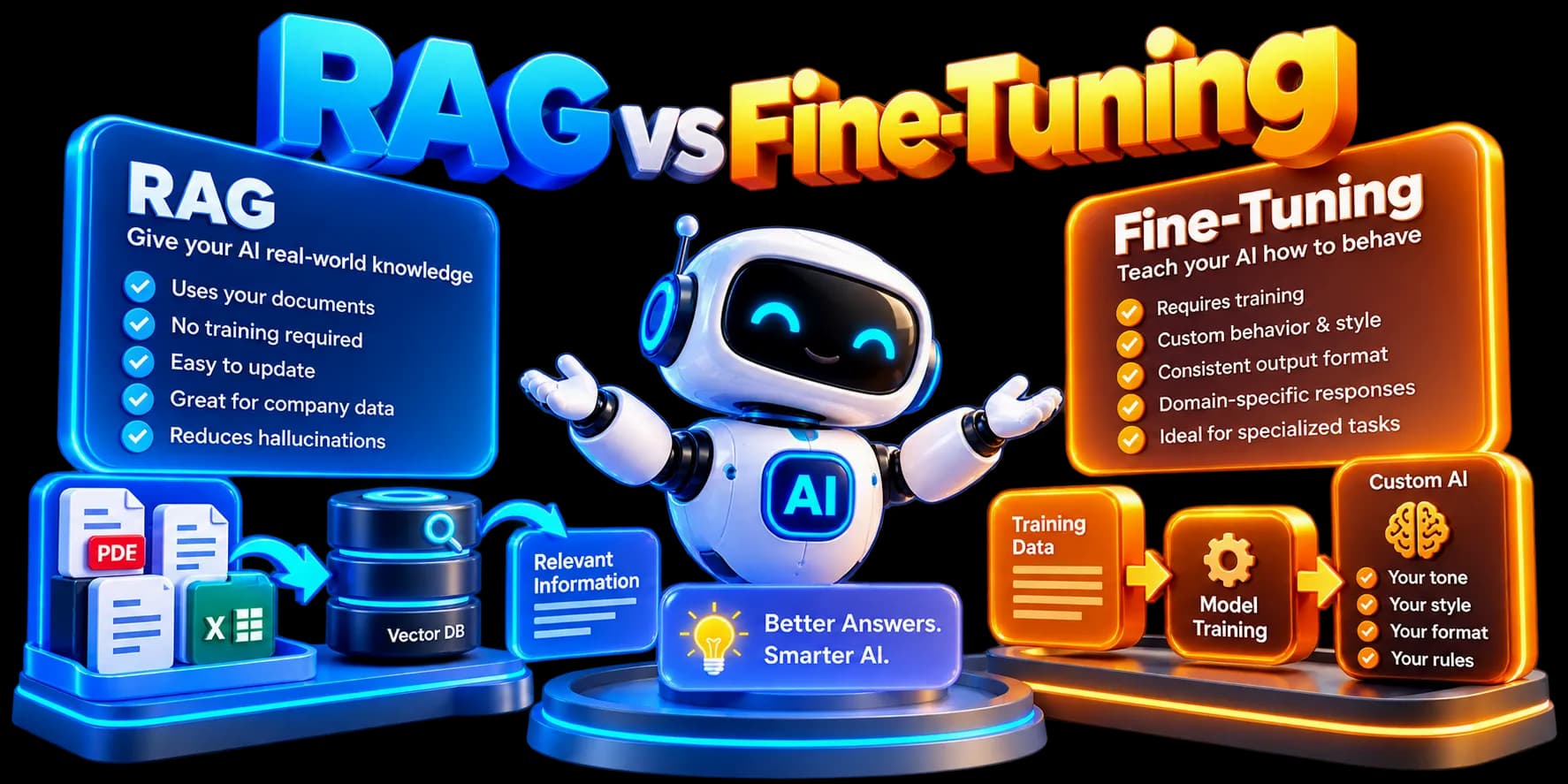
Retrieval-Augmented Generation (RAG) acts like an open-book exam. When a user asks a question, your application converts the query into a high-dimensional vector, searches a vector database (like Qdrant or Pinecone) for contextually similar text chunks, and injects those retrieved snippets into the system prompt. The foundational weights of the base model remain completely untouched.
Fine-Tuning acts like studying for months before a closed-book exam. You feed thousands of curated input-output pairs into a model using methods like Parameter-Efficient Fine-Tuning (PEFT) with LoRA (Low-Rank Adaptation). This updates specific attention layers in the network, permanently altering its baseline tone, syntax, or reasoning format.
RAG in action: Building a production chunking and retrieval pipeline
Below is a complete, runnable Python script using LangChain and ChromaDB to index domain documentation and answer user questions with accurate source attribution.
from langchain_community.vectorstores import Chroma
from langchain_openai import OpenAIEmbeddings, ChatOpenAI
from langchain_core.documents import Document
from langchain_core.prompts import ChatPromptTemplate
from langchain_core.runnables import RunnablePassthrough
from langchain_core.output_parsers import StrOutputParser

# 1. Prepare enterprise knowledge snippets
policy_docs = [
    Document(page_content="Squarebrackets refund policy: Students receive a 100% refund if cancellation is requested within 7 days of course start date. After 7 days, pro-rata processing fees apply.", metadata={"source": "finance_v2.pdf"}),
    Document(page_content="DevOps Batch Timings Noida: Weekend batches run Saturday and Sunday from 10:00 AM to 1:30 PM IST at Sector 62 campus.", metadata={"source": "schedules_2024.pdf"})
]

# 2. Store vectors locally
embedding_function = OpenAIEmbeddings(model="text-embedding-3-small")
vector_db = Chroma.from_documents(
    documents=policy_docs,
    embedding=embedding_function,
    collection_name="institute_policies"
)

# 3. Define production retriever
retriever = vector_db.as_retriever(search_type="similarity", search_kwargs={"k": 1})

# 4. Strict prompt template preventing hallucinations
system_prompt = """
You are a helpful support assistant. Answer the user question using ONLY the provided context snippets.
If the answer is not contained within the context, respond with 'I do not have access to that information.'

Context:
{context}

Question: {question}
"""

prompt = ChatPromptTemplate.from_template(system_prompt)
llm = ChatOpenAI(model="gpt-4o-mini", temperature=0.0)

# 5. Build RAG Chain
rag_chain = (
    {"context": retriever | (lambda docs: "\n\n".join(d.page_content for d in docs)), "question": RunnablePassthrough()}
    | prompt
    | llm
    | StrOutputParser()
)

# Run query
response = rag_chain.invoke("What is the refund rule at Squarebrackets if I cancel on day 3?")
print(response)
Architectural comparison: RAG vs Fine-Tuning
Here is how both approaches compare across critical operational metrics when deploying in product teams.
| Dimension | Retrieval-Augmented Generation (RAG) | LLM Fine-Tuning (PEFT/LoRA) |
|---|---|---|
| Dynamic Data Updates | Instant (update vector DB record) | Slow (requires re-training job) |
| Hallucination Risk | Low (grounded by context snippets) | Moderate to High on fact lookup |
| Primary Purpose | Access to external/private facts | Style, format, and domain phrasing |
| Upfront Infrastructure Costs | Low (vector DB + embedding calls) | High (A100/H100 GPU compute setup) |
| Latency Impact | Adds 50-200ms vector retrieval step | Zero retrieval latency overhead |
Common mistakes when picking between RAG and Fine-Tuning
In our live online cohorts, we regularly review production architectures from engineers. Here are the three errors developers make most often:
- Fine-tuning for live facts: Training a model on your latest company handbook means you have to retrain every time policy changes. Use RAG for fresh or frequently changing facts.
- Using RAG to fix JSON syntax: If GPT-4 keeps dropping quotes in your specialized SQL output, do not build a bigger vector store. Fine-tune a smaller model like Llama 3 8B on 500 validated JSON schema examples.
- Ignoring chunking strategies: Standard 512-token fixed-width chunking often splits critical context across boundaries. Sentence-level or semantic chunking is essential for clean RAG retrieval.
Production considerations for enterprise deployment
When moving your solution to production on AWS or Azure, remember that vector indexes require cache invalidation strategies just like Redis. If an employee updates a ticket in Jira, your background worker must delete and replace the exact vector chunk in Chroma or Pinecone immediately.
For fine-tuning, prioritize PEFT and QLoRA over full parameter training. Quantized 4-bit fine-tuning drops memory requirements significantly, allowing you to train Llama 3 8B models on a single consumer GPU like an RTX 4090 instead of renting multi-node A100 clusters.
Where to go from here
Understanding RAG and fine tuning explained practically comes down to one rule: use RAG to give your model memory and facts, and use fine-tuning to teach your model form and style. Combining a fine-tuned lightweight model with a robust RAG vector retrieval pipeline gives you the ultimate balance of low latency, accurate responses, and minimal cloud compute expenditure.